The Obscurer

Go West

Interesting programme on Channel Five yesterday (and it’s not often you hear me say that) with Mikhail Gorbachev presenting Big Ideas That Changed The World; in this case the big idea being communism. We were given a little potted history of communism, which was interesting if not revelatory, but interspersed with Gorbachev’s own commentary it became quite fascinating.

Gorbachev is still clearly a fan of Marx’s theories, and was at pains to stress how the central planning, repression and cult of personality of the Stalin era had nothing to do with the Communist Manifesto. Growing up in a staunchly communist family it is little wonder Gorbachev was attracted to the theories at first; less so when you learned that his grandfather, who was a party member, was tortured by the secret police for withholding some grain for his family. Self-delusion seems to have been, to some extent, the order of the day, as Gorbachev’s grandfather insisted that Stalin could not have known the true barbarity of the regime; today, Gorbachev tells that he has seen with his own eyes the execution orders signed in Stalin’s hand.

But despite this early eye-opener into the Soviet Union’s totalitarian nature, Gorbachev became a loyal party worker, and rose rapidly through the ranks. The Red Army’s success in the Second World War actually illustrated one way in which central planning, however brutally applied, could be a huge advantage in times of war. Following the end of the war, as communist governments sprang up across eastern Europe and the world, as Gorbachev recalled the Soviet superiority in technology, sport, the arts and the space race, and while Khrushchev made some modest reforms, you can imagine how Gorbachev, amongst others, would be unlikely to question communism, and could see it as a system for the future.

For Gorbachev, disillusionment set in when Brezhnev replaced Khrushchev and turned the clock back to the Stalinist era of centralisation, the arms race, tyranny and ultimately stagnation. Gorbachev laughed when he remembered politburo meetings that even discussed the minutia of the production of women’s underwear.

When he became leader he was still an advocate of communism, but wanted it to be reinvigorated with greater freedoms and democracy. Today he speaks of how Marx’s followers (but not Marx) did a lot of damage, by suppressing trade and enterprise, and much of what drives a normal society. Interestingly he also believes that the west needs its own perestroika; that capitalism suppresses other human values of equality and solidarity, and that the lesson from communism, that it is an error to try to suppress universal human values, can equally apply to capitalism. I am not quite sold on this theory myself, but certainly I feel that any strict adherence to one ideology is likely to be a mistake, and that capitalism is capable of some pretty unpleasant outcomes that we should not turn a blind eye to. Surely, just as elements of free market liberalism were required in the Soviet Union to make it a more free society, so in the west the state must also play an important role in making society a fairer one. Many people seem to have an automatic aversion to either markets or to state involvement, but I think they both have a role to play; it is just a question of balance. But I am repeating what I have said in previous posts, now, so I will shut up.

One final thing, though; this programme was also a timely reminder of Europe’s recent history. As the television screen was filled with images of the Berlin Wall being torn down, Gorbachev spoke of how he refused to use the Red Army to intervene as the old communist leaders of eastern Europe were swept from power. I couldn’t help thinking of how, last year, when he died, Ronald Reagan was considered almost solely responsible for the dismantling of the communist regimes and the end of the cold war. This year it was the Pope’s turn. No doubt next year, when Thatcher dies, she will get all the plaudits. I think that Gorbachev, more than anyone else, deserves the credit.

Veggie Chile (Slight Return)

Well, I am back off holiday (yes, I had a lovely time, thanks), and the world appears to still be turning despite the hiatus in my blog. This is the first chance I have had to bash anything out, and I suspect posts will become less frequent and more brief from now on, but who knows. Stay tuned, if you can be bothered.

I have landed back home in the middle of National Vegetarian Week, but I won’t be joining the celebrations; after all, I had about eighty vegetarian weeks in 1993 and 1994, so I have done my bit for the rest of my life I suspect. Fair play to those who have lasted longer at this meat free lark than I managed; in the end the smell of grilled bacon and roast chicken became too much and I lapsed.

I suppose that it is events such as National Vegetarian Week that irritate some people about the vegetarian movement, and vegetarians in general; the stereotype of a pasty faced evangelist trying to ram his or her opinions (and some braised soya bean curd) down other peoples’ throats, but this seems unfair to me. Every vegetarian I know, or have known, has been supremely indifferent to what I eat; they have never pushed their opinions on me and have never complained about my preference for eating dead animals. I have probably encountered more lobbying from those people following the latest fad diet – the hay diet, the Atkins diet, the South Sea Bubble diet – than I have from vegetarians; at least vegetarians don’t look at a simple ham sandwich as a contradiction and a paradox, like a riddle wrapped in a mystery inside an enigma then wrapped in bread.

What a difference compared to when I was a vegetarian, and carnivores regularly questioned my motivation and reasoning behind spurning meat. Unless you are, or have been, a vegetarian then it is probably hard to understand the general grief you have to put up with just for eating a Quorn fillet. It can range from some people just thinking you are a bit odd to others actually arguing that to not eat meat is itself wrong. Of course most people were fine and even supportive during my flirtation with vegetarianism; but there were still enough people who seemed to have such a problem with it that it makes me smile whenever I hear people complain about vegetarians being intolerant of meat eaters. During by stint, a stranger even called me a weirdo when I collected my vegetarian pizza from a take away; although I suppose there are plenty of other reasons they could have had for thinking I am a bit strange.

Still, if you are one of those people who gets wound up by the antics of those you perceive as being pushy vegetarians, just think on if you could be a pushy carnivore, and let them be. Unless they are one of those annoying, superior vegetarians, of course, because they do exist; then do as you please.

Cattle Prods And The IMF

I probably shouldn’t be writing this, after the amount of Stella I have been drinking tonight, and at this time of the night/morning, but time is pressing. Anything I write that is particularly stupid will be deleted in the morning, leaving only the plainly stupid to remain. What the hell; here I go.

As you may have noticed, I haven’t managed to do any live-blogging of the general election. It was never going to happen. I was watching the television coverage in bed by 1 am, and I was asleep by 3 am; so kudos to NoseMonkey, amongst others, who managed to cover the whole event. I hope their insomnia is soon cured.

Here in sunny Cheadle the LibDems managed to turn a tiny majority of 33 into a comfortable majority of 4,020. Bizarrely, in the most marginal seat in the country, the Con Club at the top of my road only put up their “Vote Conservative” posters last week. They really didn’t deserve to win here. It looks as if the LibDems won because of a collapse in the Labour vote. I really don’t understand this whole business of swings, though. The BBC website reports a 4.2% swing from Conservative to Liberal Democrats, when if you look at the figures, the Tories vote was largely static, while Labour voters switched to the LibDems (Cheadle is fucking weird, though; this time there was a swing to the LibDems; in 1992 the Tories increased their majority. Madness).

Across the country a similar story seems to have emerged. Labour has simply shed voters in all directions; they have done a starburst towards any other party. The war seems to have played a larger part in the election than I suspected it would, but Labour are still by far the largest party in parliament. There was never much doubt that Labour would form the government in this election, but next time it may not be so clear cut, and so it will be interesting to see if in the next election people still feel they can afford a protest vote against the government. Whatever people think of Blair, or the war, I don’t think that there is a feeling at the moment that people want to see the back of Labour, whereas in 1992 the country was thoroughly sick of the Tories and wanted them gone, they just lost their nerve in the polling booth; by 1997 nothing short of divine intervention could have saved them. In improving their share of the vote by just 0.6% this time it still doesn’t seem as if the nation is particularly enamoured with the Conservatives just yet.

Well done to Jon Chatfield by the way, an old college friend of mine, for increasing the LibDem vote in Cambridgeshire South East; I was in the land of nod, unfortunately, by the time that result came through. I was also sleeping for the exchange between the God-like Paxman and the twattish Galloway (no prizes for guessing which side I am on in this argument), but thanks to the wonder of the Internet you can watch it again (and again) here. Wherever you stand on the war, I think it is a terrible thing that Galloway has won in Bethnal Green and Bow; egos like his don’t need feeding any further. I would like to think that he has delusions of grandeur, but unlike Kilroy he actually does seem to have some supporters; and let’s face it, they are welcome to him. On a better note, I am happy that the deeply irritating television presenter Esther McVey has failed to win Wirral West. When I heard they were doing various recounts in the constituency I did hazard a guess that she had lost, but just couldn’t accept it. I don’t know the woman, so I may be doing her a disservice, but that is the way it appeared to me.

I mainly watched the coverage of the election on the BBC which was pretty good; I just wish they wouldn’t give Peter Snow so many electronic toys to play with. That graphic of the party leaders walking down Downing Street was totally embarrassing, and I don’t ever want to see it ever again. That said, whenever I flicked over to ITV or Sky (usually when Dead Ringers’ Jon Culshaw appeared on the screen) they also succumbed to the corny graphics; it must be obligatory in the media these days.

What now? Hopefully we will see the government taking more notice of parliament this time round. Blair I suppose will have some more of his “difficult decisions” to make for a while yet, but for how long? He has looked rattled and grumpy all campaign, and I wouldn’t be surprised if he just wants out now. Some have mentioned that he would like to see Britain through signing the EU Constitution, but as there is not a cat in hell’s chance of winning that referendum (that’s if another country hasn’t scuppered it by the time it gets to us) there is not much for him to hang around for. Perhaps he may stay long enough so he can hand the leadership over at a convenient time, so Brown can still call the next election during his own honeymoon period. I guess we will wait and see.

As he has not managed to get elected I suppose Jon Chatfield’s mind will be allowed to wander this weekend to the possibility that his beloved Everton could qualifying for the Champion’s League. I sincerely hope they do, for my many Everton acquaintances such as Jon (in Cambridge, via Weymouth), Mike (Cheadle Hulme, via Formby and Canberra), John (Wallasey) and AJE (the blogosphere). I think it is quite right that if the FA have four positions for the competition then they fill them with the top four teams in their premier competition. If UEFA want their champions to appear in their competition, they should change their rules. End of story.

Will City join them in Europe? Well, it is a tough call. By tomorrow the UEFA cup could be out of reach, a slim possibility, or even in our own hands since we play Middlesbrough in out last game. Whatever happens, I think Stuart Pearce has shown enough to get the job permanently. As was said on Occupied Countryall we are saying is give Pearce a chance”. Well, he has had his chance, and I actually feel more confident about City’s progress now than I have done for a while. Off hand, I can’t think of anyone I would prefer to be our manager.

And at the bottom of the table? Well apologies to Saints fans, but I really hope Southampton go down. It is about time. I never used to mind them; they used to have the Le Tissier for one thing; for another, they allowed my ultimate hero, Gio Kinkladze, to carve them open for this goal. However, the very same season that Kinky scored that goal Southampton and Coventry both stayed in the premiership on goal difference while we were relegated. The following season both clubs once more finished just above the relegation places, and I decided they were living on borrowed time. Employing Gordan Strachan as my emissary I despatched him to get both sides relegated. He worked wonders at Coventry, and when he left them for Southampton it all seemed to be falling into place. It was my idea for him to initially be successful at Southampton in order to avoid suspicion; but during the Saints’ “relegation year” he let it slip that he would be leaving at the end of the season; so he was sacked and Southampton survived. With luck, perhaps this season is the time that my thwarted ambitions are finally realised.

So, in this post we’ve had politics, and sport; what about Fimbles? Well, hopefully I will have a few weeks free from their annoying influence. I am off on holiday tomorrow for a fortnight; to Rumbling Bridge in Perthshire for a week, followed by a further week in Bowness on Windermere (picture above). Where I go, I hope Cbeebies can’t follow. As a consequence there will be no blogging from me for the next few weeks, unless I spot a passing Internet café by a lonely tarn, and even then…

I will see you all in a couple of weeks; take care, and look after yourselves.

PostScript: if you are unhappy about a Labour victory in the election, then just look at what you could have won, (via Shot By Both Sides). Not far from the truth, if you ask me (but did you?).

Signed D.C.

I’ve already written that if it’s a straight fight between being legal or illegal, then I believe the Iraq War was illegal. In brief, I think that even if you agree that Iraq was in material breach of UN resolutions, and you accept that the cease fire after the 1991 Gulf War is therefore rescinded, and that consequently in 2003 we were once more at war with Iraq, the existing resolutions only allowed us to use military force in order to liberate Kuwait, not to invade Iraq and remove Saddam. Unless someone explains where it states that there was some authority for coalition forces to go beyond the Kuwaiti border, then I will stick by my belief that the war must be considered illegal.

Now, supporters of the war often argue that international law is far from set in stone, that it is a complicated and nuanced business, and this is true; further, it is often argued that the legality or otherwise of the invasion is irrelevant next to the moral rightness of the liberation, and perhaps they have a point. I guess if I passionately believed that a certain course of action was justified and moral, and was then told that it was illegal, then I would probably say “sod legality, let’s do what is right”. If back in 1994 a veto from a Security Council member was the obstacle preventing a UN intervention in the Rwandan genocide, then I would know where they could stick the veto and I would support any illegal action required to save lives (in practice I believe the threat of the veto was enough to stall an intervention in Rwanda).

I expect the moral case will now be made to excuse the fact that, according to the documents obtained by Channel 4 News, between the 7th and 17th of March 2003 the Attorney General’s legal advice was stripped of all its conditions and equivocations. The argument as ever will be that removing Saddam was the right thing to do, whatever the Lord Goldsmith said on the 7th. Well perhaps, but is this really relevant? What is needed now is not an explanation of the moral rightness of the war, but of the moral rightness of presenting an unbalanced and one sided version of the legal advice to parliament and the nation in order to persuade and cajole MP’s and the general public into going to war. Unless I hear a reasonable explanation for this action, or some evidence that the document is a forgery, then I will treat any reference to the war itself as an evasion. So far I have heard Clive Soley make the moral case for war on Channel 4 News, while on Newsnight Jack Straw was at his unconvincing best suggesting that all of the Attorney General’s doubts evaporated in the fortnight between the publication of the leaked document and Baghdad’s first taste of shock and awe. Straw suggested that dramatic events during that time (eg. Hans Blix saying Iraq was disarming) made Goldsmith’s caveats redundant; presumably without such vital developments the less strident version of the legal advice would have been published and we wouldn’t have trooped diligently behind the US on the 20th of March. Yeah, right. I wasn’t persuaded and will await developments.

But why am I worrying? Speaking to Sky News Tony Blair says he has never lied; not just on Iraq, but on any matter. He has never told a lie. That means that in the history of mankind he has just joined the exalted company of George Washington and, well, no one else basically. And we only really know that George was happy to own up to some minor peccadillo in his youth regarding a cherry tree; would he have been so forthcoming if he had invaded Iraq? Anyway, how can we be sure that Blair isn’t lying now? That’s the problem with liars; you can never really tell.

Shepperton Babylon

Probably the finest work Harry Enfield has ever done was a one-off spoof documentary for Channel 4 entitled Norbert Smith – A Life. In the style of a South Bank Show special, and even “presented” by Melvyn Bragg, it followed the life and career of the fictional celebrated actor Sir Norbert Smith, a sort of Gielgud/Olivier/ Richardson composite. Through various parodies of different films we see Enfield/Smith star alongside Will Silly in Oh, Mr Bankrobber; in the gritty northern kitchen sink drama of It’s Grim Up North; as the uncool father in the Cliff Richardesque Keep Your Hair On, Daddio; and performing a song and dance routine in the MGM-style musical Lullaby Of London.

At one point we see a clip from Smith’s 1964 film Rover Returns Home, introduced as being part of the Rover series of films, poor British imitations of the successful American Lassie films (it also claims to be the first film to feature the chameleon like versatility of Michael Caine…as the dog). Curiously enough I have recently found out that there actually was a British series of Rover films; but rather than being copies of American movies the first Rover film actually predates Lassie by nearly forty years. Furthermore, 1905’s Rescued by Rover features the first use of many of the innovative cinematic techniques usually attributed to DW Griffiths in his landmark film The Birth of a Nation, which was released a full decade later in 1915.

The source for this information is a new book Shepperton Babylon – The Lost Worlds of British Cinema by Matthew Sweet, and I think the above example rather neatly makes the author’s point, and indeed the premise of the book; that British films have always been under rated and under valued, and that “no-one has hated British film more than the British” themselves.

And who is Matthew Sweet? Well, according to the blurb at the front of the book he is a “writer and broadcaster” who has been, among other things, the “film critic for The Independent on Sunday, presenter of Radio 4’s The Film Programme, and a reporter for BBC2’s The Culture Show”. Strangely absent from this CV is that Matthew and I were at school together, and although we have lost touch with each other over the years I count him as a friend. So, is this post just a plug for an old friend’s book? Well, yes it is, but if you cannot plug a friend’s book in your own barely read blog, then what can you do? (Jonathan Calder has beaten me by several weeks to writing the first review of this book in a blog; he is obviously a far faster reader than I am).

Matthew’s previous book Inventing the Victorians was a re-evaluation of that era, where he sought to show how the stuffy and staid image often associated with the period is false. In Shepperton Babylon he tries to show another side to the much-derided British film industry. An author with a penchant for revisionism then? Perhaps, and both books are clearly personal views; but even if you don’t agree with the author’s opinion (and when discussing films you haven’t seen you have to take a lot on trust) the style of writing is always engaging, and you cannot read his opinions without being fascinated, and becoming more open minded about the subject.

The book follows a largely chronological path beginning during the pioneering days of film, when Hollywood was just “a tangle of cacti and orange trees”, but Hove in Sussex hosted a studio on rails that was moved during the course of the day in order to catch the sun. I think there is something inside all of us that understands the magic of those early days of cinema, some innate sense of wonder; it is the same feeling I remember from watching my dad’s old super-8 cine films which seem so much more evocative and thrilling than the DV clips I have taken on my camera, inspite of the far superior technology we have today. In the early days of British cinema film-makers were happy to create movies with such fantastic names as That Fatal Sneeze (where weights were attached to the camera to mimic the ultimate sneeze itself), The Lure Of Crooning Water and the Venetian romance of The City Of Beautiful Nonsense, and presumably kept a straight face as they did so.

That last film featured Chrissie White and Henry Edwards, who though largely forgotten nowadays appear to have been the Paul Newman and Joanne Woodward of their age, and it is surprising how often you are reminded of the present while reading about the past. In 1928, long before 9/11 and the building of the channel tunnel, High Treason concerned itself with a terrorist attack on a cross-channel rail link. If you think Little Britain is an original and inventive comedy it is interesting to read about 1952’s Mother Riley Meets The Vampire, where Arthur Lucan performs what Matthew describes as “not quite a drag act”; dressed in bonnet and shawl Lucan shrieks, “I’m a Lady…and I defy you to prove it!” It is also strange to read about the 1916 film East Is East based around a Fish and Chip shop, just like the more well known, but entirely unrelated, film of 1999.

You would expect a book of this sort to wax lyrically about a slew of lost gems, and indeed the descriptions of such films as the 1929 IRA drama The Informer (“a scene in which he offers his condolences to the weeping mother of the man he has helped to kill is as powerful as anything in Cinema”) and the early Ealing films such as Pen Tennyson’s There Ain’t No Justice, and Went The Day Well, leave you itching to see them; but Matthew is happy to put the boot in when required. The Woman From China is “comprehensively hopeless”, and as he is one of only a handful of people who have seen it he is “qualified to pronounce upon the irredeemable awfulness” of the film. Similarly, the gay western of The Singer Not The Song gets a less than favourable review, and unsurprisingly failed to kick start a new film genre.

Just reading the two pages of acknowledgements at the front of the book gives you some idea of the work that has gone into Shepperton Babylon. How many of us can say we have interviewed Googie Withers? Well Matthew can. He has also suffered for his art, and gone places I wouldn’t dare; interviewing the unbearable Nicholas Parsons for one (I saw Parsons on a TV programme the other day talking about his time as a comedy straight man where he said “Although I am not a pompous person in real life, I am very good at playing pompous characters”; oblivious to the fact that only a truly pompous man would come out with such a line). His interview with Norman Wisdom is described as “an overpowering experience: my five hours with him feel as much like a hostage crisis as an interview”; Wisdom even feels the need to “perform a comedy stumble” when they are introduced. Christopher Lee, however, proves to be a rich source of unintentional humour. Irritated that people view him as being just a horror actor, and attacking “sloppy journalism”, he states he hasn’t starred in a horror movie since 1975; which makes you wonder what sort of genre his movies Curse III: Blood Sacrifice (1991) and Talos The Mummy (1998) fall into. He must have been furious when his 1970 film The Bloody Judge, a biopic of the 17th century Lord Chancellor George Jeffreys was released as Night Of The Blood Monster. Poor bloke; even when he breaks free from the shackles of horror and appears in Eugenie…The Story Of Her Journey Into Perversion (1991) he “insists he had no idea he was appearing in a porn film”.

The book is almost worth reading for the author’s descriptions alone; Barbara Cartland is a “flushed meringue”; Gracie Fields a “clog-shod Britannia”; George Formby looks like “a human being reflected in a tap”; Diana Dors is “a monstrous Zeppelin of blondeness”; while Dirk Bogarde “manages to suggest barrack-room bullying and buggery just by the way he leans on a mop” in one film; in another he resembles a “quiffed eel”.

As the book tells its story it is fascinating to see relatively unknown actors (at least, unknown to me) like the fantastically named Tod Slaughter make way for more familiar figures such as Lawrence Olivier. With the rise and fall of the studio system movies better known to me hover into view before I am in unfamiliar territory again with the chapters on exploitation and sexploitation films (honest). Along the way there are hundreds of revelations, some quirky, some significant; that 1936 saw the first screen kiss between black actors in Paul Robeson’s Song Of Freedom; how Rank’s move from making big prestige films to mass-market cheaper pictures was partly due to producer Filippo Del Giudice being fired for accidentally urinating on J.Arthur’s feet; that Kenneth More’s first role in cinema was literally in a cinema, monitoring “the audience for telescopes, binoculars, opera glasses and masturbation”; that Larry Taylor featured in the sexploitation film The Wife Swappers before finally finding “fame” as Captain Birds Eye (I will leave you to make up your own jokes).

The book ends on this note, dealing with the sub-Carry On… films of the seventies, a curious time when Adventures Of A Taxi Driver out-grossed Taxi Driver and filmmakers battled to win the Golden Phallus at the Wet Dreams festival in Amsterdam. I personally cannot even abide the Carry On… films, and I am unable to share Matthew’s obvious enthusiasm for them; so when he says that Emmanuelle In Soho is “a kind of endgame for British cinema” from which “ there was nowhere to go but upmarket” you know it must have been a stinker.

We largely know the path British film has taken since then; Matthew writes that “more has been written about the last twenty years of native production than the previous seven decades put together”, and so for a book dealing with “the unknown, the forgotten, the unrecorded” it is time to call it a day. Matthew is obviously a fan of many of these overlooked films, but he is never sentimental; he even asks us not to mourn the passing of such famous names as Elstree and Shepperton. By way of an example he recounts attending a party at the old Gainsborough studios in 1999, shortly before they were demolished in 2002. At one point he sneaks off, hoping to chance upon the ghost of Ivor Novello, but instead encounters only dead and dying pigeons.

In Paul Auster’s novel The Book of Illusions the central character David Zimmer discovers the films of the silent movie star Hector Mann, and it is captivating to read Auster’s descriptions of these imaginary lost works such as The Snoop and Mr. Nobody. I always wanted to be able to watch these films, but unfortunately they are all the work of Auster’s imagination. Matthew Sweet casts a similar spell with his book; the difference being that here he is describing films that actually exist, and which you are able to see. He fires your interest and persuades you of the value of these lost masterpieces, inspires you to endeavour to track them down for yourself; and that is reason enough for me to consider Shepperton Babylon a success.

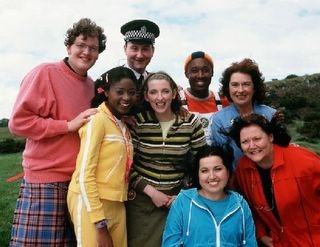
PostScript: The relevance of the picture? Well, it features the cast of the children’s programme Balamory, including the original and best Josie Jump (her in the yellow). On the far left, wearing pink, is Archie, the Inventor, who for me bares a striking resemblence to Matthew Sweet. Coincidently, next to Archie is PC Plum, who it is claimed is a dead ringer for myself. This is something I refute entirely; but in this matter, as in so many others, I appear to be in a minority of one.