The Obscurer

It’s All Over Now, Baby Blue

So. Manchester City have sacked many managers over the years, and during my time writing The Obscurer I have, in one way or another, chronicled the comings and goings of those fortunate enough to have held that most fabled of managerial posts. But, such is the strange and dysfunctional nature of this existence-hanging-by-a-thread old blog that I never quite got around to commenting on Roberto Mancini; and despite making copious notes on the subject – and having the best of intentions – I never found the time to write a post on his time at the club.

I was a fan of Mancini’s, and I was going to pen a hardy defence of his tenure. Namely that

  • I felt he was a seriously underrated manager who, due to the money he inevitably had to spend, did not get the credit he deserved for taking a side that had finished in 10th the season before he arrived and managed to turn them into Premiership champions within 2½ years. From listening to some you would think that this achievement was the least that could have been expected; but just take a look at the side which finished 10th last year – West Ham – and imagine saying that even given unlimited cash that they should consider anything less than being champions in 2016 as failure, and you can see how ridiculous such an opinion really is.
  • I was also going to defend City’s performance last year, one largely derided as a timid title defence in the face of the challenge from a mediocre Manchester United team; but United’s accumulation of points last season was anything but mediocre – indeed it was record breaking – up until the Premiership title was secured. And while City were far from stellar last year, they garnered enough points to have seen them as realistic challengers in most seasons; indeed, had we won our final home game (which, sans Mancini, we lost to Norwich) we would have gained more points than United did when winning the title two years previously.
  • And while I’d aknowledge that our performances in Europe were less than impressive, it was interesting that analysis of last season normally started by accepting the caveat that we were placed in a very tough group, and then chose to completely ignore that fact when using our Champions’ League campaign as a stick with which to beat Mancini. For me, when I saw the group we were in I knew for a fact that we weren’t as good as Real Madrid; turned out Real weren’t as good as Borussia Dortmund, and so I can’t see failing to qualify from that group as the disgrace some do.
  • And finally, one of my bugbears was the way he was treated by a media who, for whatever reason, took against him from the moment he had the temerity to take Mark Hughes’ job, an accusation I can’t remember being levelled at any other manager ever (was Hughes criticised for pinching Sven’s job, or Pellegrini for nicking Mancini’s? Not that I can recall). Being Italian certainly played into the hands of any lazy journalist who wanted to label us as being negative whenever we weren’t scoring goals for fun. And while all managers can come out with stupid statements – and I won’t pretend that Mancini was an exception to the rule – the media certainly seemed to take a special delight in taking his words and twisting them (something they continue to do even now). While he is not the only victim of such behaviour he was certainly at a disadvantage with his grasp of English which, while perfectly serviceable, lent itself vulnerable when dealing with journalists bent on mischief-making and wilful misrepresentation.

That’s not the full story, of course, although it’s probably enough to be going along with for now. But, whilst I made my notes on the matter, time passed like a thief in the night, and I never wrote that post (although I remain of the opinion). Yes, I was pissed off when Mancini was sacked, as were many City fans; but we football fans are all fickle, useful idiots to the cause, and having lived through many a managerial departure I was ready to welcome the blameless Pellegrini and a brave new era. And as expected, over time, the anger faded. But less expectedly, when the anger had faded it left behind it…well…nothing. Or next to nothing. For reasons I can’t quite fathom, when the blue mist cleared I discovered I barely cared what happened next in the City story. And while I can’t predict how I will feel come the denouement of this season, I really thought that by this stage I would have shaken off my torpor. And yet here I am; still here.

Why? I don’t know, and this post is in part me trying to figure it all out. After all, Pellegrini seems a lovely chap and we’re playing some cracking football, scoring goals left, right and centre, the squad shorn of the rancour and disharmony attributed to the Mancini era. So why can’t I just relax and enjoy it? Have all those many barren years as a City fan turned me into some sort of masochist, unable now to appreciate the good times, allergic to them? The fact that I can now occasionally be seen watching Stockport County toil in the Skrill North (the what, you say?) perhaps supports that position.

The finest football picture ever

But I wonder if I’ve been on this path for a while, ever since I decided one day that I would relinquish my season ticket. For sure there were a number of reasons for the decision, but dissatisfaction with the money-dominated nature of the Premiership was certainly one of them. Of course, that was in the days when City didn’t have money, but my opinion didn’t change once we’d won the lottery. I never thought it wrong to spend pots within the rules – City’s petrodollars didn’t break football, it was broken when we found it – but I certainly thought the rules should be such that we should try to prevent any domination by a club with cash.

Having ridden myself of the season ticket further events loosened the ties that bind; I spoke here of my despair at the antics of Thaksin Shinawatra, of Garry Cook. But it was not so easy to rid myself of City; and knowing that money is no guarantee of success I was born to follow as we moved up the league and assembled a stunning team; expensively, of course, but also a team which, in its haste, had its fair share of misfits and cast-offs. Loyalty demanded I follow them when they were shit, and now I couldn’t shake them as we moved onwards, grabbing the Premiership title in the most dramatic way possible.

But even then my spirit was flagging. I started last season with Google News as my home page on Chrome, boasting its customised “City News” section, and with a raft of football forums in my bookmarks. Even before Mancini was sacked the whole lot had gone, so tired was I of reading the never-ending bullshit and drivel. Maybe that was another sign that I’d still been tiring of football – or at least Premiership football – for a while.

But perhaps the key to my disenchantment can be found in two statements innocently issued, with the best of intentions, from within the club. First up, in his post-season interview last year, chairman Khaldoon Al Mubarak proudly announced that no longer would City be prepared to accept second best, or words to that effect. He meant well, no doubt about that, and I can fully understand where he is coming from; but for me, still reeling from Mancini’s sacking, and brought up on believing that you follow your side through thick and thin, regardless of the result, it was anathema. Let’s just say that if most City fans had that attitude we’d have done one many, many years ago, and Khaldoon current position wouldn’t even exist. What was meant as a rallying call left me shaking my head.

The second statement was made just the other week by club captain Vincent Kompany who, when asked about the chances of City completing the legendary quadruple responded

We can’t promise it will happen now, but eventually it will have to happen…We are the players at the moment who have been chosen to do it. If it’s not us then it will be other players. This club definitely has a target to win every competition possible.

Now, I imagine, when United fans think back to “that night in Barcelona” when they won the treble, their legs go all wobbly and they get a little bit emotional. They think of the drama of those late, late goals at the Camp Nou, and of the remarkable combination of skill, hard work and luck that was required for that historic achievement. Such events are what following football is all about (I myself get quite teary thinking of our play-off final against Gillingham, just a week later). Yet now, here we have a nominally even greater achievement, the quadruple, not being talked of in hushed tones and poetic hues of possibility, but in the blank prose of inevitability. And can you cheer the inevitable? Well you can, I guess; but why bother?

Am I at grave risk here of making too much of an off-the-cuff, perhaps out of context quote? Quite possibly. But I feel this encapsulates my malaise. If I’m right then I think that the sacking of Mancini was more than just the sacking of a manager I liked; it was the severing of the last link with a Manchester City of potential, where failure was a possibility, where we were a work in progress, and where if any club could mess up a gigantic cash injection it was surely my blues. When City were shit, they needed me. As we climbed I enjoyed the ride. At the summit I appreciated the view. But one false move and everything snapped back. Now Manchester City can sack a winner, the person who achieved what I thought impossible, and can just go and get a new top manager, give him £100m for new players and watch him win the quadruple. Or if he doesn’t, the manager after him will. Or the one after him. It’s a project now, rather than a football club, and it doesn’t matter who the manager or players are, because eventually, by brute force and money, it will have to happen, apparently. And this is where you’re meant to applaud.

None of which is to criticise those City fans who have taken Pellegrini to their hearts; I know many of them, and as far as I can tell theirs is the normal way to behave, and it’s me who is being weird. Again, this is I guess just the latest instalment in my growing dissolutionment with football. And perhaps it’s also because I’m getting on and there are only so many hours in the day; is it a coincidence that in the past year, as my interest in City has tailed off, I have started subscribing to The New Yorker and, against the clock, been devouring its long-form journalism on a weekly basis?

Because despite all I have said I am still a City fan, I think; it’s just that perhaps I’m a blue in the same way I’m English. Perhaps it’s all of a part with those other swirling quirks of history and birth, tied up in my being; a element of myself which I cannot avoid, and don’t want to avoid, but which I am no longer bothered about. Yes, perhaps that’s it. I’m English, and a City fan, but don’t look for me at Wembley or The Etihad. Try Edgeley Park. Or even better, my house, with my family, a glass of red, and an article on the perils of a Nantucket fisherman.

Hearsay Corner

There’s this fellow who calls himself The Heresiarch. He has a blog, and you can find him on Twitter. I’m not sure what he thinks his heresy is, but on his website he states that he’s into “countering complacency, received opinions and incoherent thoughts”; further, that he “continues to campaign against all form of orthodoxy”. Speaking truth to power, I guess; a noble cause. So how’s that going?

I don’t read Heresy Corner, or follow The Heresiarch on Twitter. But I do occasionally stumble upon his work, and yesterday was one of those occasions, when the excellent Left Outside retweeted his comment that

tweet

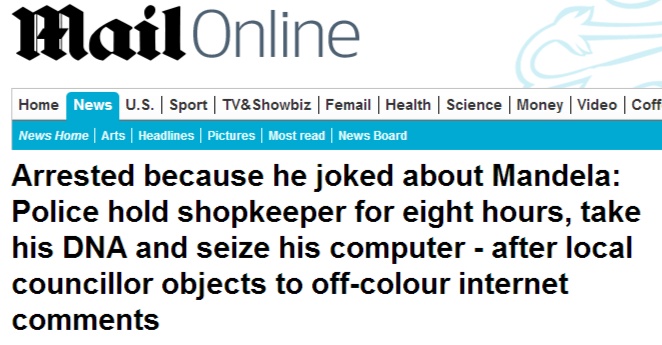
Sounds pretty bad. So what is the story actually about? Well the headline is as clear as the Daily Mail can be.

headline

But that’s just the headline. What about those all-important bullet points?

bullets

Oh no. Looks like we have another Twitter joke trial on our hands. Except there’s no reference here to Twitter. At least not yet. But let’s not split hairs; onto the article itself.

A sandwich shop owner endured eight hours of questioning by police and had his computer seized for three weeks – after making tasteless Nelson Mandela jokes on the internet.

Neil Phillips, who runs Crumbs in Rugeley, Staffordshire, says he was also finger-printed and DNA-swabbed after officers received complaints about what he insists were harmless gags.

In one online post, the 44-year-old wrote: ‘My PC takes so long to shut down I’ve decided to call it Nelson Mandela.’

So far, so bad. The Heresiarch (let’s call him H to save time and spellchecking) is rightly miffed that the police – or should that be the “thought police” – are a bunch of PC twats (geddit!), running around now that Mandela has died and arresting people for innocent if not-very-good jokes that they made some months ago. Haven’t they got anything better to do?

Sadly, though, this is the high water mark of H’s “analysis”.

Mr Phillips was arrested at his home on September 10 and was taken to a police station where he was quizzed about the postings on the Rugeley Soap Box website.

Oh. So still no mention of Twitter (don’t look, it isn’t there, not anywhere) and now we find that this whole thing happened months ago, and that it’s not just the police acting now on a comment from September. Is this news in December? Well the Mail certainly thinks so.

From there the story goes south pretty quickly. After a further bit of a protestation that this whole arrest was simply over some innocent Bernard Manning-type jokes which the unfortunate Mr Phillips had cut-and-pasted, we read that he is in fact

one of two men interviewed by police following a bitter, ill-tempered feud over plans for a mining memorial in the town centre has been ambushed by some members of the Far Right and used as a propaganda platform.

So, perhaps not just arrested for making some mild jokes, do we think?

The other individual was pensioner and former miner Tom Christopher, 72, who was quizzed by police at his home in Cheadle, Greater Manchester, over claims he issued threats on the net.

“Cheadle, Greater Manchester”? Hey, that’s where I live. Perhaps I can pop round and find out the unadulterated truth behind the sorry affair? Sadly I suspect they mean the Cheadle in Staffordshire, what with everything else in this tale being Staffordshire based. Still, that likely lazy journalistic error is far from the most important thing here. More important is that “threats” and “jokes” are not the same thing, at least according to the law, and so the introduction of this second, threatening man makes the waters ever muddier. In fairness to Mr Phillips, though, we can’t hold him responsible for Mr Christopher’s threats, now can we? All Mr Phillips did was copy a few harmless one-liners. Who could possibly be offended by that?

Liberal Democrat Councillor Tim Jones was so incensed by the one-liners, aired at a time when Mandela was critically ill, that he made an official complaint.

Ah, the guilty party. So it seems that Councillor Jones could be offended. He’d better have some pretty hard evidence to back up his obvious overreaction. What does he do?

He then sent the Sunday Mercury – a Birmingham-based newspaper – screen grabs.

One was of a shocking image of decapitation, another featuring a wheelchair-bound individual, both posted by Mr Phillips.

He said: ‘They are vile and deeply offensive, anti-Muslim, anti-disabled.’

Hmm. Whatever the rights and wrongs about Mr Phillips’ arrest, I think we’ve strayed a little way from believing it was all because of him making some mild jokes, as the Mail initially suggested and which The Heresiarch credulously accepted.

Okay then, so time to wrap this up. I could get mad with the Daily Mail here, but what can you expect? There’s nothing especially unusual about this as far as they’re concerned, it just follows their standard MO: there’s that bold headline, followed by the slightly more equivocal opening paragraph, then by the time you reach the end you find that the whole premise of the article has been pretty much denied. But, to be fair to the Mail, should you read the whole article you should at least have a fair idea about the truth of the matter. Unless you’re already tapping away on Twitter by the time you get that far.

If you even do get that far. Because I find it impossible to believe that you can read the whole article and come away thinking that someone has simply been arrested for making an off-colour joke. Forget analysis. Hell, don’t even bother with basic comprehension. To come away thinking that someone has been arrested for making a joke means you either haven’t read the article, or I don’t even think you can read.

All of which suggest that The Heresiarch really is the Daily Mail’s ideal customer. Which is fine. There are over 600-odd comments at the moment on the story, and no one else seems to have read it fully either, so H has plenty of company. And, in fairness, after being challenged, he has now deleted the tweet in question, although to the best of my knowledge he hasn’t refuted it.

But you have to wonder how this all fits in with “countering complacency, received opinions and incoherent thoughts”. Does it really rate as speaking truth to power if while you think you’re railing against the powers-that-be you’re actually just dumbly falling hook, line and sinker for the usual Daily Mail copybook scare tactics because they happen to bolster your world view? Well I don’t think it does.

So thank you, Heresiarch, for bravely standing up for what you believe in; but should I ever again stumble upon your work then I think I’ll jog on. And next time I feel the urge to read an alternative viewpoint which challenges the orthodoxy, at least now I know that I’ll have to look elsewhere.

My Name Is Changed Daily

When did the standard police practice of not revealing the names of those arrested suddenly become a bad thing? I’d always thought of it as a protection for people who are mere suspects, or could even be considered the police’s helpers (as in people who are “helping the police with their enquiries”). These people are entitled to full legal representation, and also entitled to not being the subject of gossip and speculation until the evidence is considered sufficiently strong enough for them to be at least charged with an offence. Now, however, all of a sudden this practice is being mentioned as if it is sinister; as part of a lack of transparency indicative of a “secret arrest” that must surely presage some extra-judicial disappearance. So what changed? And why? I can remember no clamour from the public to suddenly name names, so where has it come from?

While you’re here, do you remember Dave Jones? The erstwhile manager of Southampton, he was kindly relieved of that position after he had been charged with twenty-one offences of child abuse dating from when he was a social worker in Formby between in 1986 to 1990. In the event the case collapsed like a house of cards; it appeared that the police, unable to obtain the evidence to make an individual charge stick, had engaged in the process of “trawling”, whereby rather than gathering the evidence to prove a single offence they had instead presented several similar offences at the same time in the hope that the weight of each allegation would strengthen and support the other, so to produce a guilty verdict. It failed, and the police were heavily criticised for their behaviour. Fast forward a few years, of course, and various police forces were investigating various complaints against Jimmy Savile but were again struggling to make their cases. Alas, these different police forces were investigating individually and had failed to share their evidence. If only they had communicated better, it was said, then they could have pooled their investigations and surely the combined weight of these separate investigations would have strengthened and supported the other, so to produce a guilty verdict? But that didn’t happen, they failed, and the police were heavily criticised for their behaviour.

Anyway. Back in the world of “secret arrests”; and the Daily Telegraph is vexed. It is appalled that recent police guidelines on the matter of revealing suspects names, which were previously subject to interpretation by different forces, have been tightened up to favour a policy of “not telling”. Their editorial features a lovely screenshot from the film 1984 just to hammer home where they’re coming from, in case you were wondering. Their nose has been especially put out of joint by the fact that “ACPO could not be convinced by the arguments of this newspaper” in opposing the plan, and they go on to bewail that they are “a profession whose reputation has plummeted in recent years”. Oh, to clarify, I ought to point out that it’s the police they’re referring to there, not the media.

Meanwhile, elsewhere the paper reports that Keir Starmer, the Director of Public Prosecutions, is also arguing against such a “blanket ban” on naming suspects. He doesn’t call for codifying specific instances where suspects should be named, however; for instance, dangerous suspects on the run. No, instead he calls for “wriggle room”, specifically where “there’s not enough evidence to charge but there may be other allegations out there”. Okay. I guess that’s not trawling; but it certainly seems like an invitation to be trawled. Does he remember Dave Jones? Perhaps. But he’s not thinking of Dave Jones here; at least not for now (he’s not been in the papers for a bit). No, he’s thinking of Stuart Hall, and understandably so considering the role the publicity of his arrest made in further victims coming forward; but forgetting, perhaps, that, Hall pleaded guilty before his case made it far as Jones’s did.

In truth I have no strongly held feelings either way on the matter of naming suspects. I can for sure see the pros and cons in both approaches, and although I think calling for “wriggle room” is a bit like calling for “more vagueness and confusion”, I just hope Starmer’s statement is a considered one which takes account of the long view, and is not one largely based upon whatever is flavour of the month today. But I’m ultimately glad that I’m not the one who has to draw the boundaries here; and I’m especially ultimately glad that the Telegraph’s noble position is based upon their firm, long-running and continuing commitment to our individual human rights, and not upon their displeasure at being initially thwarted in splashing Rolf Harris’s name across their front page at the earliest possible opportunity.

For The Avoidance Of Doubt

I’d written a quick draft of that rare thing called a “post” last Thursday when a phone call from school signalled a sickly daughter who needed collecting and caring for, and therefore the consigning of said draft into a saved items folder. And now the sickly one is back at school, and I’m not in work, and I’ve cast my eyes over the draft and decided it’s more-or-less fit to post as is, with minimal tidying-up, so I may as well.

For it’s the tax avoidance versus tax evasion distinction that was and is a frustrating one for me, relying as it so frequently does on such lazy thinking. Often is seems enough for someone to simply say, “ah, tax avoidance, remember, is perfectly legal” and consider it job done, as if “legal” and “right” are synonyms. We saw a close cousin of this attitude during the MP’s expenses scandal, with many of our elected representatives protesting that buying Persian rugs and duck islands at the taxpayers’ expense was within the rules and therefore fully justified and defensible. But we don’t, I think, feel that morality is or should be wholly defined by the law, or vice versa. And so the “tax avoidance is perfectly fine because it’s legal” argument is self-evidently bollocks.

For myself I think that tax avoidance is such a broad term that it is not an especially useful one. At one extreme you can have someone whose accountant is simply trying to make your money work for you by ensuring that you take full advantage of any tax reliefs available. Tax relief, I think we can assume, is put in place to encourage certain behaviour, be it home ownership, philanthropy, investment or whatever. Regardless of whether you think government should be promoting such things, it seems almost rude not to take the treasury up on its offer to partake in such activities. Personally I would baulk at even calling such things tax avoidance. They are, rather, just part and parcel of common sense money management and planning. At the border of the other extreme is, of course, tax evasion, which is illegal, plain and simple.

It is the middle ground where I think true tax avoidance lies; and “lies” seems to be the appropriate word. Take the K2 scheme that Jimmy Carr has been unfortunately vilified for (and I say unfortunately because I doubt he devised the scheme, and he’s surely not the most egregious example of tax avoidance in the country (that’s not even mentioning that there seem bigger fish to fry than tax avoidance) but is being picked on mainly for being famous; although, even at the most sympathetic face-value reading you would have to wonder why he didn’t ask questions when he was told his tax rate would be plummeting to 1% rather than just assume all was well). Insofar as I understand the scheme (and I doubt I do), money is received as income, but then rather than being taxed at source as it would be for (probably) you and (definitely) me, it is spirited away to a “company” in Jersey, and then “loaned” back to the original recipient at a vastly reduced tax rate. It is those inverted commas that show why it is dodgy; the company is not just any old financial institution providing a variety of services, but a shell existing solely to temporarily house someone’s income (yes, income); the loan is nothing of the sort, rather it is said aforementioned income being returned to that original someone minus the usual amount of tax. In short, the company and loan are a fib. What type of fib? May I suggest a big fib, and quite possibly a fat one as well?

That for me is true tax avoidance. It differs from tax evasion only in that it is considered legal, but it is considered legal only because the law hasn’t yet caught up with it; rather like a brand new hallucinogenic drug is legal only because the law cannot ban something that hitherto hasn’t existed, oh but it soon will. It is a world way from a financial expert carefully stewarding your money through the thicket of tax reliefs and exemptions to reduce your tax bill and ensure you don’t pay any more tax than you need to; rather it is a flagrantly dishonest procedure designed to shirk your genuine tax rate. And if we started referring to the former as, say, “tax planning”, and reserved the term “tax avoidance” for the latter – or even called it what it is, namely “tax evasion which isn’t quite illegal…yet” – then I think this debate may become a little more intelligent.

Death of The Obscurer?

image