The Obscurer

Category: Economics

Terry’s All Gold

Yesterday Stephen Gerrard joined the fray in calling for some sort of quota system restricting the number of foreign players in the Premier League. What can have influenced his judgment? Could it be the sheer mediocrity of many of the foreigners he has played alongside at Liverpool that has blinded him to the valuable contribution many of the imports have made? Would he, I wonder, be as well disposed towards some sort of quota system should it scupper a future move to AC Milan or Real Madrid, were Italy and Spain to also introduce some measures to “protect” their national teams?

There certainly appears to be a groundswell of opinion growing surrounding the matter of imposing quotas on foreign players in football. This week Michel Platini and Steve Coppell joined Sepp Blatter, Alex Ferguson and others in supporting restrictions on foreigners in the game, mainly on the grounds that it will help the development of indigenous talent. This is bollocks, of course, and the matter shouldn’t need detain us for long. Do we really think that those English players who do break through to Premier League level are anything other than vastly improved by the fact that they play alongside and against superior foreign talent? It seems so blindingly obvious to me, but so it goes. Presumably those calling for quotas are sincere in believing that such moves will remove those foreigners currently blocking out our native talent and so allow more Wayne Rooneys to grace the top flight of the game, but that begs the question “why are the foreign players here in the first place?” I am equally as certain that such moves will just guarantee our teams are cluttered up with more Ben Thatchers and similar and so protect their exalted positions. Certainly, looking back to a time before the influx of foreigners into the game I can’t exactly remember a surplus of homegrown Rooneys; rather my memory is littered with grim visions of a legion of Thatchers, and sub-Thatchers. It seems clear to me that regarding the quality of the players – if not the entertainment – we are much better off these days (and incidentally, my antipathy towards Ben is purely down to his very average performances while playing for my club, and not because of his surname, although that probably didn’t engender my instant respect.)

Perhaps more complex is the whole matter of players’ wages, but there was a similar almost-consensus the other week when, with David Beckham now more or less out of sight and out of mind, John Terry assumed the mantel of being the footballer-most-likely to be used to criticise footballers’ salaries in the Premier League. Sports minister Gerry Sutcliffe apparently “slammed” the “obscene” salary of John Terry and others; although as is often the case when it is reported than someone “slams” something, rather than making an orchestrated attack on the subject Sutcliffe probably just fielded a reasonable question by providing a reasonable answer. What was the response from the very highly paid world of football to the question of whether John Terry and other footballers are too highly paid? Well, Gordon Taylor of the PFA said, “every labourer is worth his hire and Mr Abramovich thinks he’s worth it.” Chelsea boss Avram Grant countered, “everybody likes to speak about the money of the footballers. Why does nobody speak about singers who get more money in one year than any player?” Manchester United’s Alex Ferguson similarly said, “there are some tennis players and golfers earning enormous amounts of money. Is that wrong?” while Arsenal manager Arsene Wenger correctly pointed out that “we are in an economy where the company decides who pays who and how much and we have to respect that.” All is true, but all avoid the question of whether or not football players’ wages are obscene, and the simple answer to that is “yes, of course they are.” Or, if not exactly obscene, then certainly a bit daft.

Personally I have no major objection to the top players earning such daft sums. There is a shed load of money in football at the moment, and when you get a unique talent like a Wayne Rooney being competed for by a number of clubs with pots of cash then there is only one way the price is going to go; that’s just the way it is. I’m actually much less comfortable with journeymen like the aforementioned Ben Thatcher who, while poorer than Rooney, is still mega-rich. Despite having played for many teams, I’ll bet no football fan has ever welcomed Thatcher on arrival at their club, or mourned his passing; his existence in the Premier League is seemingly more down to every team needing 11 players and the league needing 20 teams; and he’s not all that bad you know, I mean I suppose he’ll do. Quite why such a bog standard talent should benefit from being (theoretically) in the same market as someone like Rooney I’m not too sure, but it seems he does. This is something I think is more obscene, if obscene is the right word; Thatcher being quite rich, rather than Rooney or Terry being stupidly rich.

But even regarding top players like John Terry, I do think it is interesting to consider just what forces have led them to their massive income. There is hard work obviously, the drive and ambition to succeed that will have led other similarly gifted or more talented players to fall by the wayside, and that is to be applauded; however hard work is only a part of it. Putting in the same hours as a cricketer, or a chartered surveyor, would result in a far more meagre reward for Terry, no matter how hard he worked; part of the reason for Terry’s wealth is the good fortune that comes from being able in a field that has so much money swirling around it. To that stroke of luck you can add another other stoke of luck, that of Terry having a natural talent for football in the first place; no matter how hard I work at my football I will never be good enough to play anywhere other than my back garden, even the local rec is beyond me. And returning to all that hard work Terry must have put in to get where he is today, even then that “drive and ambition” I mentioned earlier must surely be part nature, part nurture. In summary, then, Terry’s salary is down to being blessed with a natural talent (luck), in a very well rewarded sport (luck) alongside his own efforts (partly luck). Well good luck to him I say.

What to do? Well in the first instance, nothing. I would much prefer for Terry and others to earn the money they do than for there to be some individual salary cap or maximum wage, either in sport or in the wider economy; but this is where taxation comes in, and where for me one of the better cases can be made for a redistributive – or at least a more progressive – tax system. Critics of income redistribution often deride their opponents as envious whingers who moan childishly about redressing society’s “unfairness”; in contrast it is said that taking from the hardworking and giving to the feckless is, well, “unfair”. But as I have said, being hard working is only one of the variables that has led John Terry to his riches, and I don’t think that footballers are a unique case; luck can come in many forms. It is worth saying at this point that I am far from convinced that tax should be used for redistributive purposes, to simply take from the rich to hand to the poor; rather I can see the sense in the rich paying proportionally more in tax than the poor simply because they can more easily afford to, although I concede that in practice they are probably pretty much the same thing.

Have we come all this way just to read a defence of progressive taxation? Well yes, I reckon, it certainly looks that way to me, that and as an excuse for me to make use of the title “Terry’s All Gold”; but sometimes I just feel that the self-evident needs to be evidenced, or something, and we’ve had fun along the way, haven’t we? All I guess I’m trying to say, if I’m even trying to say anything, is that while some people may complain about Premier League salaries, the alternative to footballers – yes, and singers, tennis players, golfers and others – earning vast sums seems to involve unpleasant things like dictatorship and authoritarianism; far better to happily let such people earn their silly money in the first place. But then, rather than bluster that they simply deserve their subsequent wealth, they should accept their good fortune and realise that it’s not unreasonable for them to pay back through taxation a share of what they owe the system that allowed them to earn such absurd amounts of money in the first place. Fair’s fair.

Oh, and as for the matter of quotas for foreigners; footballers – and all other workers while we’re at it – should pretty much be able to work wherever the hell they like; don’t you think?
Well Oil Beef Hooked

When people criticise labour markets as being skewed and requiring regulation, they tend to mean that the employer has far greater bargaining power than the employee. It seems obvious that the corporation has the upper hand over the individual, so we need unions and/or employment laws to protect the latter against the former. So it is interesting to read this recent(-ish) article from The Economist regarding the situation those all-powerful oil firms face in Alberta, Canada, and the problems they have in recruiting staff.

It seems that “drug abuse in the northern oil patch is more than four times the provincial average”, and that

about 40% of the workers test positive for cocaine or marijuana in job screening or post-accident tests. Companies worry about lower productivity (due to absenteeism or sloppy work) caused by drug abuse, and the safety risk. On drilling rigs and in oil-sands mines a small mistake can easily result in injury or death. Some experts believe Alberta’s rising job-site accident rate (up 17% in two years to 180,000 cases in 2006) is partly due to drug abuse.

Most of the biggest companies conduct drug tests before hiring, as well as after any accident. But many workers have learned to get around these with synthetic-urine kits from drug-paraphernalia shops. Many smaller contractors prefer to turn a blind eye for fear of losing workers in such a tight labour market. Lawrence Derry, an addiction expert at the University of Alberta, says that one contractor told him that “if I brought in drug testing, I’d lose half my crew—they’d go right over to my competitor.”

So there we go; reports of the oil companies’ evil omnipotence have been overstated, the employment market is not as simply one-sided as has been assumed, and we can all calm down a bit. Do we really need unions and protection for employees after all if they wield such power?

But doesn’t this example make the same basic point; that however much we may wish it, the market does not provide solutions to all our problems? Sometimes it will work perfectly, but at other times employees are at a disadvantage; sometimes, as in this case, it is the employer who is on the wrong end of an asymmetrical relationship.

It is probably fair to say that no employer in Alberta wants drugged up workers on its books; that some still put up with them is because they feel the market leaves them with no choice. This recalls some of the points that have been made regarding the recent smoking ban I mentioned a few posts ago; some opposed the ban on the grounds that because the market sanctioned smoking in pubs most people must have been happy with the situation. But isn’t it also very possible that most landlords, bar staff and customers would have preferred a smoke free environment, and that it didn’t happen without legislation because landlords were scared to lose custom, bar staff didn’t want to lose their jobs, and customers, subsequently faced with a choice of a number of smoke-filled venues, had to put up, shut up or stay at home.

Anthony at The Filter recently(-ish, again,) complained that the ban was down “people failing to get their preferences through the market, and therefore turning to government”; but isn’t that one way to describe market failure, and so a possible justification of a role for government? If the majority of people would prefer a smoke free environment – and whether related or not, my local is now busier than ever on a Friday night – and the market didn’t provide it, then has the recent legislation done us a real favour? And even if you feel that smoking per se isn’t a suitable area for government intervention, isn’t the principle of government intervention to alleviate a market failure sound?

Let’s face it, the market is a brilliant concept; anyone who has ever spent a chill December evening in Manchester’s St Anne’s Square with a steaming mug of gluhwein in one hand and a chargrilled bratwurst in the other cannot fail to appreciate that fact. Given half a chance I think I would prefer the market to decide on the provision of pretty much everything; but it should be the servant, not the master, it is there for our benefit, not to dictate to us. Where the market fails to provide it should never be enough on its own to allow us to just shrug our shoulders, say “well market forces have spoken”, and so justify the status quo and signal the end of the debate. Perhaps all things considered a “market failure” is a sign that we should do without; but more needs to be taken into account before we can arrive at that decision, and if necessary we shouldn’t be afraid look elsewhere – to the charitable sector, or, as a last resort, to government – to remedy the situation.

Addendum: Anthony makes some interesting points in the comments, and as a result I feel the need to clarify my position.

I am making two main points in this post; first a general one, that markets are imperfect, and so I don’t therefore feel you can justify the status quo in any given situation by simply assuming that market forces have already delivered what people want. The second point, more specific to the smoking ban, is that I can well imagine that more landlords, staff and customers would prefer a smoke free environment than wouldn’t, and so the recent smoking ban on health grounds has inadvertently addressed that situation.

How can the market have failed to respond in this instance? I would say that landlords would have been reluctant to go smoke-free unilaterally even if they had wanted to knowing that while other pubs did allow smoking they would lose the custom of their current clientele who are smokers and their friends; it would be a gamble to hope that enough new non-smoking customers would be attracted in to replace the shortfall, and I doubt in practice that would happen. With an outright ban, however, where all pubs must multilaterally go smoke-free, there is not the same concern. There is a worry that some smokers will stay at home, but I doubt they will in any numbers if at all, and in addition pubs are now more attractive places for those who would previously have steered clear because of the smokiness.

But that is just me speculating, and what I am not saying is that I would support a government intervention because Westminster bureaucrats know better than pub landlords, and should engineer a situation to increase the popularity and profitability of pubs. If the ban were simply a case of the government trying to second-guess consumer demand then I would rather leave such things to the market. A ban designed to protect the health of staff is I feel far more justifiable, but may as a consequence have delivered what more people would prefer. Time will tell if that is correct.

As Anthony says, “perfection is not for this world”, and I don’t think the state should tinker in every little thing where is could be perceived that the market is imperfect. But neither do I think that government intervention should be criticised on the grounds that market forces would simply have sorted things out if there were a genuine demand for it.

Coffee Republic

Despite the Thatcherite revolution of the ‘eighties that promoted privatisation and put nationalised industries to the sword, there is still much ideological discussion about exactly how and where the private and public sectors should operate, about where each sector should draw the line. Nowhere is this perhaps more true than in China as it continues its global economic advance; but evidence that some people there are still having trouble trying to understand the respective roles of government and enterprise is revealed in this news story reporting that the branch of Starbucks in Beijing’s Forbidden City has been closed down following an online campaign.

The leader of the protests, Chinese television star Rui Chenggang, complained that the existence of the coffee shop “undermined the solemnity of the Forbidden City and trampled on Chinese culture”, and you can understand his concerns. After all, the Forbidden City is over 500 years old, its historic pagodas form a world-famous UNESCO heritage site, and traditionally in Communist China if anybody was going to indulge in a spot of culture-trampling then it was going to be the state, not big business. It is no wonder then that the campaigners feel baffled and confused, not to say a bit peeved.

China’s emergence into the modern world has been haphazard to say the least, and stories like this illustrate just how far they have yet to go. But I have every confidence that in time they will continue to allow the state to withdraw while giving private companies the freedom to expand into the vacuum, so to bugger things up in ways only the government has hitherto been able to. Because in the end it isn’t the speed you travel, but your direction that is all-important.

Yee-Haa!

I’ve just had a brilliant idea. This week’s announcement of an increase in the minimum wage from £5.35 to £5.52 an hour gives me the perfect bogus pretext to dust off and resurrect that half written, half thought out post on the minimum wage I was faffing about with in November, before the birth of my daughter child caused me to reprioritise. So here, for what it’s worth, is my fully written – but, I hope, still half thought out, and certainly half baked – musings on the subject. So what are we waiting for?

I had been wondering, you see, how little seems to annoy economists more than when boneheaded thickos like me refuse to unreservedly accept that the minimum wage is a bad policy that costs jobs. Why can’t the public get it into their daft heads and just accept that the policy is flawed because real economists instinctively oppose it?

This assumption, of economists’ antagonism towards the minimum wage, took a bit of a hit when over 650 of them – including some prominent names – signed this declaration that argued in favour of just such a policy in the US, stating that “a modest increase in the minimum wage would improve the well-being of low-wage workers and would not have the adverse effects that critics have claimed” and that “the weight of the evidence suggests that modest increases in the minimum wage have had very little or no effect on employment”. So much then for the economists’ consensus.

Of course, this was still mocked by opponents of the minimum wage. Café Hayek inducted all those who had signed the declaration into their “Hall of Shame”, stated that the signatories must “believe that demand curves are vertical”, and asked, “how can you sign your name to something like that and call yourself an economist?” That, I guess, is how you maintain a consensus; by cutting adrift and blanking out those who disagree with you.

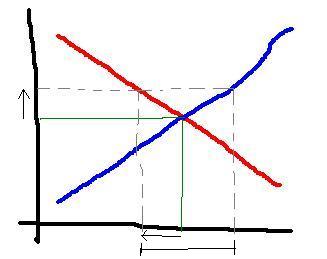
Now it is a good line of Café Hayek’s, saying that these rogue economists believing in a vertical demand curve, but I think you can get too hung up on such details. I remember being told about the unemployment effects that can be caused by the minimum wage when I studied for my degree, and it certainly makes sense. If memory serves, the diagram explaining it goes something like this.

And before the minimum wage was introduced in the UK I myself cautioned against it, flaunting the meagre economics knowledge I had gained from my shiny new BSc on the subject (many years ago; now my 2:2 looks old, tired and tarnished, and I don’t know where you can buy Duraglit these days).

But surely you don’t need knowledge of economics to see the harm that a minimum wage can do? You can forget curves and their angles; at its heart the idea is simple. An increase in the minimum wage means an increase in costs for any business that employs people on the minimum wage. Businesses have to deal with that. They may absorb it from their profits; they may pass the increased costs onto their customers in the form of higher prices; but some may seek to cut costs as a consequence of the increase in their wage bill, and one way to cut costs is to lay off staff (or reduce their hours). In addition, for some firms an increase in the minimum wage, and so costs, may be the difference between just staying in business and going bust. True, such companies are likely to be in a pretty precarious financial position as it is, and just as likely to go bump with the next strong gust of wind; but still and all, the inevitable consequence of a minimum wage is that some people may lose their jobs.

But why single out the minimum wage for such criticism? If you want to rail against the minimum wage, why not rail against anything that imposes costs on companies? Health and safety laws for example, not just the frivolous kind that make the front page of the Daily Mail, but any such intervention that puts helmets on builders’ heads or prevents lorry drivers from mimicking a single-crewed Le Mans race while on the road? Or interests rates? Perhaps we should never raise interest rates because that too can cause problems for business and increase their costs? We should never raise interest rates, for whatever reasons. Or increase taxes under any circumstances whatsoever. I don’t know what we should do when commodity prices rise, but we had better think of something soon.

Of course we can’t do much about the price of commodities on a global market, so business will just have to deal with that. And taxes, and H&S laws? Well again, they are clearly needed at some level, so we must grin and bear them too. Interest rates? Well, obviously, they may have to rise at times, for the greater good, to control inflation or whatnot, as long as they are raised at a careful and sensible level, as long as we don’t go mad and quadruple them overnight. But can’t the same apply to the minimum wage, if it is introduced or raised at a sensible rate? I see loads of adverts in shops and pubs near where I live advertising for staff at the minimum wage, not a penny more. They don’t seem to be looking at redundancies, quite the opposite, and God knows what they would be offering if they weren’t forced to pay more. Can’t the minimum wage be seen in the same light as health and safety, tax and interests rate rises, as something that may need to be done to protect certain parts of our society even if it can also have some negative effects?

Great if you are the one getting the pay rise, it could be said, not so great if you are the unfortunate one losing your job in society’s reshuffle as it digests the increase in labour costs. And it is true, for every action there can be an equal and opposite reaction, and unintended consequences too. But for me, I would take this criticism of the minimum wage more seriously if those making this point and shedding tears for the losers from a minimum wage didn’t tend to find their tears drying up when discussing the jobs similarly lost through offshoreing and globalisation, through industry consolidation and productivity drives, or any other form of profit chasing that can cause job losses. If you think a policy is justified then you think it is justified, in spite of the negatives consequences (just as long as those negatives don’t outweight the positives).

Continued after this musical interlude…

https://youtube.com/watch?v=CDIGaiNO270

But need there be job losses because of a rise in the minimum wage? Not if you think that the demand for labour is vertical, ha ha. Unfortunately for Café Hayek, their opponents who signed that statement in favour of a minimum wage rise don’t believe this either. They clearly state that a rise in the wage will have “very little or no effect on unemployment”; so they accept the possibility of job losses. Even then, though, I have to ask; how do you view economic models? Are they precise, are they definite, are demand curves perfect sloping lines you can fix a point upon to show the impact of policy decisions? I’m not an economist so I wouldn’t really know, but I say not.

Take the Laffer curve, the theory that states that a cut in the tax rate can lead to an increase in taxation revenue. It is often denounced as a “back of the envelope” theory that cannot be proven, but really it is an accurate truism. At a 0% tax rate there is clearly no tax revenue, while at a 100% tax rate there is still no revenue because everyone will bugger off to a more benevolent country with a generous 99% tax rate. Between these two zeros there must be some sort of curve of tax revenue that rises then falls as the tax rate increases. If you are the right side of the apex of the curve then in theory you can cut tax and still see an increase in revenue. This is no good for policy making – no one knows how the curve is drawn, or where we are upon it – but as an insight into how things work I think it is useful.

And I think the same holds true for demand curves. Of course they slope down, and that is good to know. More people will want to employ me if I say I will work for £1 an hour than if I want £100 an hour. An employer who may be happy to employ me for £1 may tell me where to go if I demand £5.52. So the minimum wage is bad and causes unemployment, no?

But what of the demand curve for Rolls Royce cars? Is that vertical? No, it too clearly slopes down. Demand for a Rolls Royce at £15bn a car? Nil. For £15? Loads. But; taking the current price of a Rolls Royce (which I confess I just don’t know, I’m really not in the market for one), would demand fall if the price rose by 1p – a “modest increase”, as the signatories of the pro- minimum wage statement ask for? No it wouldn’t. What about £1. Clearly not. £100? Unlikely. £1000? I still doubt buyers of new Rolls Royce’s would even blink at such a price rise. £10,000? Now you’re talking, probably. A £10,000 increase in the price of a Roller would hit demand for the vehicle, so the demand curve for the things does slope downwards, it isn’t vertical; but that doesn’t mean that any price rise will cause a reduction in demand. Actually, I don’t know why I picked such a strange example. What about something simpler, more down to earth like a Mars bar. Will demand for them fall if the price rises by 1 or 2p? Will it balls, but economic theory suggests it will. In short, theory suggests that as price rises, demand falls; in practice, price often can rise with nish effect on demand, especially if such a rise is in line with inflation. I think the demand curve, like the Laffer curve, should be viewed as a general illustration of how economics works rather than as a precise analytical tool, or a blunt ideological instrument of scientific fact.

So we’re agreed are we; that a minimum wage needn’t be opposed in principle, it can be accepted as a necessary tool in the policy makers’ toolbox even if, like other elements of policy it can have some undesirable effects, and it may not even cause these side effects anyway? Good. But in reality, is it the best way to help the poor and the low-paid? Ah, well, that is a different question altogether.

Immigrant Song

I was never entirely convinced by the Tories’ conversion to “green” policies, so it was encouraging that with their “Damian Green” policy they sounded like they were right back on track.
I’m talking about them talking about immigration, of course, and it is always fun to revisit the subject, especially in the light of the twattish John Reid stating that “we have to get away from this daft so-called politically correct notion that anybody who wants to talk about immigration is somehow a racist.” He is right, of course – I’m talking about immigration right now – but I think it is also valid to say that often, when people complain about immigration, racist is indeed exactly what they are.

Times change. Not that long ago all asylum seekers were castigated as bogus felons who were really just economic migrants. Now the bandwagon has moved on and everyone is having a pop at the economic migrants themselves, especially in the light of Romania and Bulgaria’s impending accession into the EU.

The figures from the Home Office regarding the number of migrants from the recent accession countries certainly appear to have caused a stir (perhaps 600,000 rather than the expected 15,000), but why? If you feel there is a problem with immigrants, what difference do the actual numbers make? If you think foreigners are causing you a problem, then were you to discover that in fact only 500 Poles had entered the country that would be irrelevant. Similarly, if you feel that we have absorbed recent migrants brilliantly, if it were revealed that in reality over 5 million have entered the country it still shouldn’t matter. What is the right number of immigrants anyway? Don’t ask because no one can answer, save for a few hard-line racists who tend towards the zero figure.

Recent complaints from places such as Southampton and Slough have made the point that recent arrivals have put a strain upon public services. But have they? Latest figures show that 94% of recent immigrants are working and paying taxes to provide for those services, quite possibly paying additional bus and train fares for empty seats on public transport while “native Brits” (copyright Laban Tall) sit in their cars. But Manchester too has recently complained that the large increase in the city’s population since the last census is not reflected in the grant they receive from central government, but their increase is largely a result of internal migration rather than an influx of foreigners, due to increased housing in the city centre. If local government grants don’t take account of recent population increases, then that is a fault in the formula in funding local services rather than with immigration per se. What’s the difference in essence?

What about the complaint that recent migrants depress the wages of, say, plumbers? Apart from the fact that evidence for this is often thin on the ground, are we saying that plumbers should be a protected profession where their supply is limited so that the rest of us have to take a day off work for the pleasure of waiting in all day for a plumber to fail to turn up, and then pay an artificially exorbitant call out charge when he finally does arrive? Perhaps while we are at it we should cut the number of places at college for trainee plumbers so we can further cement the existing plumbers’ market power? I don’t think so.

But regarding immigration, things have been getting a little bit weird. Traditionally the “left” have favoured immigration, while the “right” have largely opposed it; but recently, certain bloggers’ favourite whipping girl Polly Toynbee has been arguing against open borders within the EU, as has the well-respected Labour MP Frank Field (I say well-respected, I’ve always thought of him as a bit of a tit, but there you go). In which case I think this is all a useful reminder of what I have argued for ages; that stated differences between right and left are overwhelmingly silly and pointless. For one thing, there was always the fact that while you could define the right as racist and the left as internationalist, you could also point to the right as being for free markets (and free movement of labour) while the left supports government intervention (including immigration controls). This is still a generalisation, however, and I prefer a simpler definition of the argument; that it is not between right and left, but between right and wrong.

Strip away the surrounding arguments and I think most people fall back into a default setting. Some start from the point of view that immigration is wrong; their liberalism, so to speak, comes from the practical, grudging acknowledgment that some newcomers may be required to push around hospital beds, or diagnose cancers, but really they are against immigration. On the other hand there are others who say that ideally anyone from anywhere can move to anyplace, that we should have full freedom of movement; that regrettably this is may not always be practical – for example, we may not currently be able to have totally open borders for people to emigrate to a country just to claim state benefit unless we are determined to bankrupt the country – but the onus should be on proving how a new immigrant can damage our economy. I know that you should respect others’ points of view, but in my opinion it is clear cut; the latter are right and the former wrong.

You may say that most people are somewhere in the middle, but at heart I think people fit into one of the two camps. Many may sound pro-immigration, arguing for greater numbers into this country; but if they stress the fact that it is simply for the good of our economy, and that immigration is in our gift rather than an inalienable right, then they fit into the first group. Meanwhile, some of the recent left wing converts to the anti-immigration line may lie in the latter group, that they support open borders in principle but genuinely feel recent immigrants are doing harm; but as with their right wing brethren their evidence seems more anecdotal than factual.

I don’t think there has ever been a time when some people haven’t said “okay, I’ll admit we’ve handled previous immigrants well, and they have contributed to society, but this time enough is enough, we can’t handle more, we are full up”. I suspect that following the accession of Romania and Bulgaria, if there are no restrictions placed on movement and when the British economy has failed to implode as a consequence, the arguments will move on to Turkey’s attempts to join the EU. However, I start from the viewpoint that a Manchurian and a Mancunian have exactly the same right to be allowed to live in Liverpool if they so wish; and if the debate is between right and wrong then I am happy to be on the right wing.

Update 28/8/06: My wife has just pointed out that the line “I prefer a simpler definition of the argument; that it is not between right and left, but between right and wrong” is a corny load of old toss worthy of Tony Blair; and I have to agree. Criticism noted. I will try not to do it again.

Update 12/11/06: Speaking on this morning’s Sunday AM, and discussing immigration, shadow home-secretary David Davies said “this isn’t actually about whether it’s right or left, it should be about whether it’s right or wrong”. I feel physically sick.