The Obscurer

Month: September, 2008

Take The Biscuit

Last week in an interview shadow Chancellor George Osborne revealed how

the Prime Minister had barely spoken to him since they fell out three years ago over a Parliamentary vote, when Mr Osborne refused to cover for the then-Chancellor by pairing with him.

That’s intended to reflect badly on Gordon Brown, no doubt, but I don’t see why. If I regularly had to deal with Osborne in a professional capacity then I too would be looking for any flimsy excuse to wriggle out of my responsibilities. There is something I find instinctively dislikeable about the man, and you should remember my bias when you read this post. However, I tried to listen to his conference speech yesterday with an open mind. I’m not sure I succeeded.

Last year you’ll recall Osborne’s pledge to raise the threshold on inheritance tax brought the house down, prompted a surge in popularity for the Tories, and made Brown abandon any plans he had of holding a general election. The question now was whether Osborne could repeat the feat this year.

The headline grabber this time around was a proposed freeze in council tax; this was unfortunate, from a Tory point of view, as the “Labour has done it again” comment reflecting on the current economic crisis seemed to me to be a far more effective bit of political rhetoric and a fine narrative to run with. Instead, for those who could be bothered to get past the “credit crunch” news headlines to read about the Conservative party’s conference the main point they will have taken away is that the Tories have come up with a convoluted dog’s dinner of a proposal that is not really a council tax freeze at all. How it will play out in the country only time will tell, but I really have my doubts about the policy. Anything that is apparently paid for by those damned elusive “efficiency savings”, located as they are somewhere between the holy grail and the golden fleece, has to be questioned. The savings that have been mentioned include cutting advertising, regional agencies and management consultants; but I’d be amazed if advertising spending amounts to all that much, cutting regional agencies while increasing central government funding to councils seems a retrograde, centralising step, and while you would be hard pressed to find anyone with a lower opinion of management consultants in general as I have, the idea that we can just sweep them all away at a stroke to cut costs seems absurdly naïve. All this, by the way, while on the other hand Osborne announced setting up the independent “Office for Budget Responsibility” to monitor government’s fiscal policy and shadow Health spokesman Andrew Lansley trailed the creation of “Healthwatch” to act as “a national consumer voice” for the NHS. I assume neither of these bodies will be charities staffed by volunteers.

The reason for such an odd plan – to freeze council tax rather than to simply cut taxes – is because of the gloomy economic situation we are in, and to hammer home the fact that the Conservatives are serious politicians, hampered by Labour’s legacy of profligacy, and are not merely reckless tax cutters. “We will make sure that this mess never happens again,” assured Osborne, making a promise he must know he cannot keep, or perhaps mindful that he can always claim that a completely different mess happened to occur on his watch. But for the here and now “the cupboard is bare,” he lamented; there is simply no money for any “up-front tax giveaways”. While he managed to lower his voice from his usual shrill whine in a stab at gravitas, he admitted he could not promise to similarly lower taxes, and indeed elsewhere he has said that he may even have to raise them.

But just a minute; I thought the Tories had pledge to cut taxes, or at least to cut a tax; for cast you mind back a year and that is effectively what the promise to raise the threshold on inheritance tax to £1m amounts to. Opinion polls still regularly attest that this is a hugely popular move, thought I’ve never quite been able to figure out why; but as the Tories ladle on the dire news that they cannot promise tax cuts overall, the fact that they can promise one for the richest 6% of estates seems all the more inequitable. The more the Tories lower their voices and talk of lean times for all the more that pledge on inheritance tax seems to stick out like a sore thumb. So how come the support? How have they got away with such a freebie for a rich minority? Where is the sense of righteous moral outrage?

The promise to raise the threshold on inheritance tax has rightly been seen as a turning point in Conservative fortunes that has helped to propel them towards government. But if this is the only tax cut that George Osborne can promise while admitting that taxes overall may have to rise, then rather than being a popular vote winner that pitches him into 11 Downing Street this policy should really have 94% of us reaching for the pitchforks, the torches, the tar and the feathers.

Political Economy

I’ve largely kept out of discussions about the current financial crisis, and in a bit I may well wish I had maintained that position. I try not to talk about issues I don’t really understand, and international finance is certainly one of those issues. On the rare occasions when my eyes don’t glaze over at the merest mention of short selling and hedge funds my grasp of the subject itself is at best tenuous. Still, that doesn’t stop opinions from bubbling up within me from time to time in need of release, and this blog seems the obvious place to do that very thing.

And I like The Economist, I do, although I often skip the Finance section. I’ve subscribed to it for a number of years and I intend to continue. But good God does it have its faults. Don Paskini, for example, wasn’t far of the mark when he said

I’ve heard people say [The Economist] is very good because of its international coverage. On closer inspection, its international coverage turns out to be articles from round the world about the need to cut taxes, privatise services and deregulate in [insert country here].

And I have nothing against cutting taxes, privatising services and pruning regulation myself, but The Economist tends to hold so dogmatically to these ideas, laughably so at times, and so it can be easy to dismiss a paragraph here or an article there as simply lazy space filling plucked from the ideological section of their style guide, where the “public sector” anywhere is always “bloated” – or at the very least “inefficient” – and so to blame for whatever failure is imagined, even if the failure appears to be of the market rather than of government.

So to this week’s Economist leader, discussing, of course, the recent financial problems. And it’s fine stuff in the main, much I agree with. But then, towards the end, we read

Regulation is necessary… But naive faith in regulators’ powers creates ruinous false security. Financiers know more than regulators and their voices carry more weight in a boom. Banks can exploit the regulations’ inevitable blind spots: assets hidden off their balance sheets, or insurance (such as that provided by AIG) which enables them to profit by sliding out of the capital requirements the regulators set. It is no accident that both schemes were at the heart of the crisis.

And that’s fair enough in the main. Of course a naive faith in the regulator is wrong. But is that any worse than the naive faith that financiers “know more than regulators”? It is touching that The Economist still feels emboldened to make such a bald assertion in these times, but haven’t bankers pissed away any unquestioning faith that once went their way? I’ve never met a generalisation I didn’t hate (even if I issue as many as anyone) and this simple comment crystallises the bugbear I have with some of the recent comments on the financial crisis. I mean, if financiers are that much better than the regulators then they have done a good job of hiding it recently, especially considering their risks. After all, bankers have a far greater incentive than regulators not to fuck up royally, so what is their excuse? It is gratifying, in a way, to find out that those described by some as the very cream of the global market for “talent” can be quite as inept in their field of expertise as I am in mine. (And not just inept. In an article I read somewhere last week one particularly brainy employee from the UK arm of Lehman Bros. complained about the better treatment the US employees were receiving and so vowed never to work for an American company again. What a clot.)

The credit crunch can appear at times to be a canvas on which one can project whatever opinions one already holds; or at least that seems to be the case judging by some newspaper opinion pieces and from within the echo chambers of the blogosphere where sober analysis is at a premium. Perhaps the only change in some has been a new found acknowledgement that government can be good for something (ie. good for $700bn.)

On the one hand those opponents of capitalism, markets and globalisation have been handed their ammunition on a plate; but the joyful conclusions drawn, that rapacious capitalism is fucked and global finance cracked beyond repair, are simplistic and flawed. At least I hope they are, as does the manager of my pension fund. In reality we will get through this; there will be changes to regulation, lessons will be learned, and then we will carry on again in our own sweet way until the next financial crisis, when it will be realised that we overlooked something else again.

It is the opposing views that interest me more however since they seem more perverse; the defensive glossing-over and scapegoating that has gone on, the search for blame that fits in with existing prejudices. Hence in some we see the pointed criticism of the regulators given more weight than the grudging criticism of the financiers, reminiscent of the way voices complaining about the failures of a social worker can drown out those criticising the parents of an abused child; how for some it is the police rather than the murderer that is are more to blame when they fail to prevent a stabbing, or it is in fact the terrorists’ fault when the police feel forced to mistakenly gun down an innocent. It is to be expected, no doubt, but it drives me up the wall. So we hear this bleating that the regulators have failed, which they have to an extent; but it is a second degree failing let’s not forget. We are then warned repeatedly that if there are to be any regulatory changes we should ensure that they are appropriate and not of the knee-jerk variety, that there is a danger in bad regulation, or too much regulation. Do we need such statements of the bleeding obvious? To those I sense are still instinctively opposed to regulation then it seems the answer is “yes we do”. But an excess of anything is bad, and to voice such a truism adds nothing of any real value to the debate. We know that water is essential to human life, but also that drinking too much of it or drinking it badly can be fatal; we don’t need to be told this, and I would suspect anyone who felt the need to state something so basic to be either a simpleton or to be trying to diverting attention from something. Look, a bird! Obviously we need regulation that is as “just right” as Baby Bear’s porridge, but we can take that as read. We know all this. And we also know that Goldilocks is a fairy tale.

Some critics go further, however, and blame regulators and central banks for not only failing to prevent the current crisis but for helping to create it, which can seem like just another bit of blame shifting to me. So the argument is made that existing regulation is bad because it made banks look for weaknesses in the regulators’ armour, to hide items off balance books and away from regulators’ prying eyes, to surreptitiously duck capital requirements and to be forced into a lack of transparency which is where much of the damage was done. They just couldn’t help it, bless them. But isn’t it the height of naivety to believe that if there wasn’t such regulation the banks’ actions would all be honest, above board, adequately insured and funded? Isn’t this like blaming the number of dogs killed in illicit dog fights on the law banning dog fighting in the first place; to then draw the conclusion that this problem would never have occurred at all if dog fighting hadn’t been made illegal, so forcing it to operate underground; and to then warn against any tougher enforcement of the existing law as that may exacerbate the problem? Well, that makes about as much sense to me.

As for central banks, there is a general belief that Alan Greenspan helped create our predicament by cutting US interest rates too low and holding them down for too long in response to earlier crises; but how comforting to be so wise after the fact. Sure, these criticisms of Greenspan were always there, and kudos to the people who have held onto this opinion through thick and thin, but this was always a miniscule minority view, barely audible when he retired from the Fed to almost universal acclaim. Now this complaint is pretty much the consensus position, and other central banks have also shared in the blame for having too loose a monetary policy (but with less justification as far as I can tell.) The impression given is that keeping interest rates higher during, say, the dot com boom, would have been the obvious cost-free policy solution without any further consequences; and it may have been. But it also may have tipped the world into recession there and then, we just don’t know. Gordon Brown’s announcement of no return to boom and bust was always a hostage to fortune, but in all fairness developed countries have seen more of a period of sustained growth rather than a boom over recent times (asset prices notwithstanding) and higher interest rates could have put that at risk. It is easy to suggest different policy decisions in hindsight knowing they cannot be enacted and that no ill can befall the economy as a result.

Which is not to say that central banks didn’t make mistakes and perhaps did keep interest rates too low for too long, but even then surely this can only lay the groundwork and create the conditions that allowed the banks to chase illusionary pay days and to lose sight of their own risk management; there was no compulsion, no one put a gun to the financiers’ head. I’m not seeking to have a go at the banks here, or to seek to deny the important work they do, it’s just that they are at the heart of the storm and those that failed should take the bulk of the blame regardless of whatever else was going on around them; the fact that others were at fault should be an aside, not the set-piece soliloquy that some have sought to make it. After all, do we blame the proprietor of the All-You-Can-Eat Chinese Buffet when we pig ourselves sick? Do we say that it is Wetherspoon’s fault that their cheap beer leads some people to empty their stomach’s contents in a taxi at four in the morning? Some may, but they’re dicks. Whatever happened to personal responsibility?

I’ll go now as I have wittered on for too long and I now appear to be drowning in a sea of weak analogies. All I will add is that in common with most people my opinion hasn’t shifted with events. I believe in a mixed economy, in the power of the market and in the necessity of government; they both have their role, they both have their faults, and I don’t like seeing people trying to shift the blame from one to the other, not when it doesn’t seem deserved and not when it looks like a transparent attempt to deflect attention and to defensively bolster one’s own ideology.

Bin And Gone

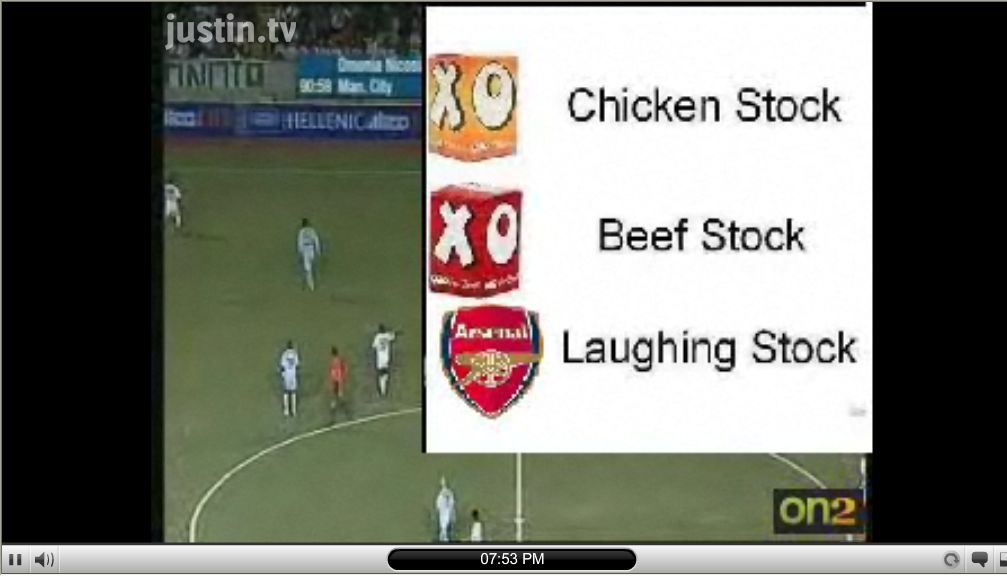
Well you’re due a short post after my recent extended blatherings, so here it is. And I guess I can’t really complain, viewing pay-TV for free via the internet, piggy-backing parasitically on someone else’s football feed. But still and all, it’s a bit annoying while watching a match to find a bit of editorialising suddenly popping up, obliterating a half of the screen.

It could be worse, though. A previous interruption, that I was too slow to catch, declared, “Bin Laden is a Gooner”. Also, I never actually missed a goal because of such anti-Arsenal interventions, although then again I was eating my tea while listening to GMR at those specific times.

It’s still better than paying for Sky, mind.

Lawn Sausage

Someone kindly left Tuesday’s copy of the Daily Express lying around at work, and I present the front-page story to you now as a kind of public service; for in these uncertain economic times, who knows? Should we find ourselves having been made redundant we may have to consider applying for all sorts of jobs that we wouldn’t otherwise look twice at; and if the job centre advertises a vacancy for an Express hack then we may have to swallow our pride in the pursuit of being able to put bread on the table. Tuesday’s paper, then, could prove invaluable, providing for the uninitiated a perfect template for creating an Express lead story, and if you stick to this script then you could get a head start in the interview and selection process. Now, I must point out that I am well aware that the tabloids engage in far more disgraceful behaviour that that featured in this story – see Anton Vowl, for example, on the handling of the recent terror trial – but Tuesday’s paper was a more typical example of what you would be expected to write if employed by the paper, and so is the perfect beginners’ guide. And anyway, it was the only paper I found discarded by an obliging colleague this week.

First the headline: “NOW THEY WANT TO BAN YOUR LAWN”. No they don’t, reply the sane; but remember we’re dealing with Express readers here, so this headline is perfect. At this point a normal person would probably want to skip to the end of the article, to find out the truth in the story which is no doubt completely at odds with the headline; but where’s the fun in that?

The story itself concerns the idea that

An army of town hall snoopers could soon be telling people what they can and cannot grow in their gardens. Fast-growing plants and even lawns could be banned, under Labour’s latest environmental blitz. People would be forced to get planning permission to make changes in their gardens in order to help the Government hit its targets for reducing waste.

Town hall snoopers, of course, are just the latest group to join Muslims and asylum seekers in drawing the Express’s ire, usually for invoking the RIPA to engage in the sort of surveillance that private sector firms like insurance companies can conduct without any such regulation whatsoever. Foolishly, councils have been going around attempting to fulfil their remit and legal obligations by, say, trying to prosecute respectable middle-class people when they have commited a littering offence, whereas we all know that only feral youths should be punished and face the full force of the law.

At this point you may feel there is a need to flesh out this story with a fact or two, perhaps even present some evidence such as a quotation or excerpt from some document detailing any plans. Don’t. Get straight into the quotes from the usual suspects denouncing the proposals, no matter how flimsily you have presented the case. First up you’ll need a compliant Tory MP, in this case Bob Neill, the local government spokesman.

Are they really expecting hardworking people to go along to the council to get building regulation consent to plant their rhododendrons? This is another example of the heavy hand of Labour needlessly meddling in people’s lives.

So he asks a question, and then makes a judgement prior to getting the answer. Excellent. As a bonus, in our example we are then treated to a second Tory MP, backbencher Phillip Davies.

I am gobsmacked that this is something the Government thinks is worth wasting their time with. They should be concerned with saving gardens by stopping developments being built on them, not intruding further into people’s private lives. If this is what Gordon Brown’s latest relaunch amounts to, then God help us all.

This is great, as it ties this story into Gordon Brown’s alleged relaunch, which the media have already judged a failure regardless of whether or not it exists. By now, however, we have learned a little more about these “astonishing measures”, which

are put forward in a policy document commissioned by the Department for Environment, Food and Rural Affairs. Some lawns could be banned because eco-experts claim that “mulched gardens” are better for the environment. They say that lawns need extensive watering and people toss cut grass in with normal household waste. Gardeners would also be told to avoid plants that need a lot of water.

The eagle-eyed will spot an interesting choice of words there; “commissioned”, “could”, “avoid”. That covers the author’s back, and Express readers will not pick up on such subtleties, they’ll be too busy raging that they want to be allowed to engage in idiotic activities like stuffing compostable materials into plastic bags before burying in a landfill.

Now we need a comment from a think tank or pressure group. In this case the person who has too much time on her hands is the unlikely sounding Doretta Cocks from the equally unlikely sounding Campaign for Weekly Waste Collection.

It is dreadful to think that they are going to start spying on gardens as well.

And I guess it would be, if it were true, we just don’t know yet. Finally, always but always get the TaxPayers’ Alliance to round off your list of reactions to vague speculation by cutting and pasting their usual response. Actually, they probably have a tacit agreement with the Express to allow journalists to attribute whatever words they fancy to the TPA in any article as long as it rails against the public sector, so you can write what you like here. In our example “Mark Wallace” is the name randomly generated as the supposed TPA spokesman.

The Government and town hall officials should realise by now that they are not doing their basic jobs properly, so there is no way they should poke their nose into [insert specific here]. The last thing people need is more busybodies bossing people about.

We should all be interested in how our taxes are spent, but I’m not sure who died and made the TPA our proxy, and on what grounds they can justify their role. I’ve long thought it ironic that they can complain about government waste; yet just what is their contribution to society? If it didn’t exist newspapers could easily come up with such rent-a-quotes another way. How can TPA employees find the nerve to accuse others of having “non-jobs”; how do they fill up their hours? Whatever, free thinking certainly doesn’t seem to enter into it.

We now get a few more vague points where the emphasis is mine: “the report also suggests swingeing taxes on items such as single-use barbecues”, “The moves could raise the price of a pack of disposable razors to £5”, “Bans on junk mail and free newspapers are also suggested”, “Hilary Benn is understood to be among those pressing for councils to have control over residents’ gardens”. They are somewhat bolder in proclaiming “the report backs moves to introduce crippling “bin tax” charges”, although of course we get no specifics, and I have to doubt whether the word “crippling” or anything like it features in the report itself.

So to the very final line of the article, and it is now, and only now, that you should actually reveal the truth and offer the target of your criticisms a right of reply, but you must do so in as throwaway a manner as possible.

But a Defra spokeswoman said yesterday the report was a discussion document and “does not necessarily reflect Government policy”.

So that’s that, this is a non-story, just some ideas being kicked around in a consultation document that Defra has commissioned. But don’t worry; you’re writing for the Express remember, and such nothingness is still eminently qualified to be a front-page splash about banning lawns.

That is the end of the road for this specific article and it is perfect primer on how to write for the Express, but with a few more pointers there is always room for extra credit. In this featured story, for example, there is at least evidence of a real discussion document, albeit not one that justifies the Express’s headline; but there needn’t be anything of the sort, you can get away with pure make believe. When reporting on the trial of Kamel Bourgass, the person found guilty of murdering police officer Stephen Oake during an anti-terror raid, one Express headline read something like “Police so scared of upsetting Muslims they did not cuff suspect…and he stabbed DC Oake to death”. Not only was there no evidence presented to support this allegation, but the claim itself was not even referred to anywhere in the accompanying story or elsewhere. Subsequently referred to the PCC the Express’s job had already been done, however, neatly ticking the “Islamophobia” and “political correctness gone mad” boxes at the same time.

Also, it is essential that you ensure you are up to date on the latest twists and turns in the Madeleine McCann story for which the papers have faced every way possible. It would be terribly embarrassing if you were to now invent something about how an anonymous witness had seen Kate and Gerry McCann acting suspiciously on the night of Madeleine’s disappearance when the press are once again convinced that they had nothing to do with her going missing. For the avoidance of doubt, then, the current position is that Kate and Gerry, as well as Robert Murat, are wholly innocent; Maddie is in Holland or maybe Belgium based upon grainy CCTV footage that could be of anybody; the Portuguese police are at fault for not following up every false lead, red herring and bogus sighting reported by the papers; and we have reverted to the original theory that there is nothing at all wrong in leaving a nearly-four-year-old in a hotel room with just her two younger siblings, indeed to even hint at the contrary is preposerous, and we apologise if we previously gave the impression that this was irresponsible and tantamount to neglect. Remember, however, to check the up-to-date situation just prior to the job interview, because things may have changed between then and now.

Follow these rules and that Express job could be yours. Just don’t make the schoolboy error that journalist Macer Hall commits right at the start of our featured article, including a line that he would have been better to have excised immediately as it very nearly gives the game away. When initially quoted on his response to this plan to outlaw the lawn, Tory MP Bob Neill lets (Freudian?) slip the comment

This is utter nonsense.

Indeed it is. That Defra spokeswoman couldn’t possibly have put it any better if she’d tried.
Too Many Cooks

Steve recently drew my attention to this Guardian interview with Garry Cook, the man headhunted from Nike to become Manchester City’s new “Executive Chairman”, whatever that means, and after a bit of delay and deliberation I finally stole myself to read it. And I wasn’t disappointed. In a bad way. Cutting to the chase, then, and these are the bits that stuck in the mind, for a variety of reasons.

  1. On the future: “Can we be as big, or bigger, than Manchester United? Yes. Can we win the Premier League? Yes. Can we win the Champions League? It will take time, probably 10 years or more. But if I didn’t think that, I wouldn’t be here.”
  2. On the “fit and proper person” test for football club ownership: “It is a very loose term, almost tongue-in-cheek, because there have been plenty of unfit and improper people in the league over the last 10 years.”
  3. On the Premier League: He talks of a sport rife with “greed and jealousy – I won’t use the word corruption but wherever there’s greed and jealousy there will be something else that follows it.”
  4. On Thaksin: Thaksin is “embarrassed about the indignities he has brought on the club” and willing to stand down as a director…“He’s embroiled in a political process and I’ve chosen to stay out of it. Is he a nice guy? Yes. Is he a great guy to play golf with? Yes. Does he have plenty of money to run a football club? Yes. I really care only about those three things. Whether he [Thaksin] is guilty of something over in Thailand, I can’t worry. I have to be conscious of it. But my role is to run a football club. I worked for Nike who were accused of child-labour issues and I managed to have a career there for 15 years. I believed we were innocent of most of the issues. Morally, I felt comfortable in that environment. It’s the same here.”
  5. On buying players: “We need a superstar…I’ve talked about this a lot to Mark and he sort of understands. China and India, 30% of the world population, need a league to watch and we want Manchester City to be their club. To do that, we need a superstar because, no disrespect, Richard Dunne doesn’t roll off the tongue in Beijing.”
  6. On Mark Hughes: “When we talked to Mark about coming to this club we said, ‘Don’t come if you don’t think you need a superstar.’ He said he wanted to challenge himself by managing the best players…Mark is adamant he wants Premier League experience because that is what let us down last season. Mark’s a homegrown lad, very old school. He’d rather sign players he knows, even overpay. That’s an endearing piece of what he’s all about. He doesn’t like the unknown because it takes him out of his comfort zone. He jumps out of his comfort zone when we say to him, ‘Hey, you’ve got to change this up a little bit.’ But he can’t have Roque Santa Cruz so now he’s back in his ‘uncomfortable zone’, which is that he will have to bring in someone new and develop them.”
  7. On selling players: Hughes, he says, was unfortunate because Sven-Goran Eriksson’s recruiting from abroad meant City had “players who weren’t right for the club” – especially in “the dead of winter when the players are putting on gloves and tights, there are five games in 10 days and it’s bloody tough”.Hughes was said to be against City’s plans to sell Vedran Corluka and Stephen Ireland. Cook’s take is very different. “Mark’s assessment was that he had seen the players he wanted to keep and the areas where he felt we could do better. There were a couple of players we looked at [selling] because Mark said he wanted to bring in better. We went out to sign those players, they didn’t come and we were left holding the baby.” It hardly represents a vote of confidence for Corluka and Ireland, but Cook is unapologetic. “Everyone’s for sale. If they want to stay at this club they will have to aspire to it.”
  8. On reforming the Premier League: Garry Cook has radical views on football that not everyone will agree with, not least his belief that there should be a new top division of 10-14 elite clubs with no promotion or relegation. “The fans,” he says, “would find a way to get passionate about it.”
  9. On marketing the league: The Premier League is “10 years behind” the US in merchandising. “This is the most powerful sports league in the world but also the most undervalued.” Manchester United had not “even scratched the surface and if anyone’s got a headstart it’s them.”
  10. On sponsorship: As for City, he says their behind-the-scenes operation is a “shock to me” explaining: “You look at our brand and it’s Thomas Cook. There’s something not quite right about watching us in a bar in Beijing or Bangkok or Tokyo and seeing “Fred Smith’s Plumbing, call 0161 …”
  11. On marketing the club: He was angry when a side of ex-players won the Masters tournament “using our name and our badge when they had nothing to do with us – then, lo and behold, we congratulate them in the programme. You couldn’t set up a band and call it the Drifters, so what are they doing using our name?”
  12. On the players’ responsibilities: He sees City becoming a “global empire” and “bigger than Manchester United” but feels the club is undermined by leaks to the media and suggests there is “someone inside the club with a vendetta”. He is unimpressed, too, with some of the footballers he has encountered. “They don’t understand their responsibility to the club,” he says. “Trying to get them to do something is like dragging them out of bed.”

Dispiriting stuff all told, but I suppose we’ve all said some daft stuff off the cuff and on the spur of the moment. Then, after reading this tripe, I remembered Chris referring to an interview with Cook where he made some similar claims about City becoming bigger than United, something not physically impossible but some way off yet, the date of achievement being pencilled in for some time after the perpetual motion machine has been cracked. It turns out that Chris was in fact referring to a different interview, in the Telegraph, conducted by Henry Winter. Perhaps Cook cuts quite a different figure in this different interview? Did I say different interview? The key points again.

  1. On the future: “We’ll be as big as Manchester United. If I didn’t have that goal, I wouldn’t be here. Can we win the Premier League? Yes. Will we? It might take a bit longer. Can we win the Champions League? Growing up at Nike, you don’t sit around saying, ‘Can we?’ You say, ‘We will’.”
  2. On the “fit-and-proper-person” test for football club ownership: “It’s almost a tongue-in-cheek term that you would use for Premier League football over the last 10 years. There are plenty of unfit and improper individuals.”
  3. On the Premier League: “In the draft, there’s no exchange for cash. Here it’s about greed and jealousy. Although I’m not going to use the word ‘corruption’, you can imagine that where there’s greed and jealousy then there’s something else as well.”
  4. On Thaksin: “The man is embarrassed about the indignity brought on the club and the Premier League. He said to me, ‘If you need me to resign from the football club as a director, because it would serve the needs of the Premier League, then I’m fine with that as long as that doesn’t change any other thing [i.e. his ownership]’…Is he a nice guy? Yes. Is he a great guy to play golf with? Yes. Has he got the finances to run a club? Yes. I really care about those three things. I need a left-back who can win tackles, get the crosses in and Jo can bang them in. Whether he’s guilty of something over there, I can’t worry too much about. I worked at a company – Nike – where we were accused of child labour rights issues. I managed to have a career there for 15 years and I believed we were innocent of most of the issues. Morally, I felt confident in that environment. Morally, I feel comfortable in this environment.”
  5. On buying players: “We just need a superstar. China and India are gagging for football content to watch and we’re going to tell them that City is their content. We need a superstar to get through that door. Richard Dunne doesn’t roll off the tongue in Beijing. Ronaldinho brings access to major sponsors and financial reward…Mark and I talk about this a lot and he sort of understands.”
  6. On Mark Hughes: “We told Mark not to come if he thought we didn’t need a superstar. Mark wants to challenge himself to manage the best footballers in the world. But Mark is from the old school. He would rather overpay for the player he knows than for the player where he’s relying on scouting reports. That’s an endearing piece of what Mark is all about. We can’t have Roque Santa Cruz, which means Mark’s now back in an uncomfortable zone where he will have to bring in someone new.”
  7. On selling player: Hughes was unimpressed by Cook’s attempts to sell Stephen Ireland and Vedran Corluka. “I’m not treating them like a commodity but in the two transfer windows everybody is for sale,” shrugged Cook, who admires youth products like Danny Sturridge (“a great player”) but also knows City need more experience. “When you get to the dead of winter and people start pulling the gloves and tights on and you get five games in 10 days, it’s bloody hard for them. Mark is saying, ‘We need some people with some mettle’. Mark will feel he isn’t successful if he doesn’t finish in the top six.”
  8. On reforming the premier league: To maximise wealth, Cook craves a slimmed-down elite division. “If you could central-entity the top 10 teams to create a global empire called the Premier League, I would sacrifice my own club [Birmingham City] into another division for that. Do Saudi Arabians want to buy Stoke City? Or do they want to buy Newcastle, Villa, United, City? There are 10 clubs. I’d like not to have promotion and relegation. There’s an emotion around those battles but the dynamics by which fans can get their kicks can change.”
  9. On marketing the league: “This is the most powerful sports league in the world but maybe the most undervalued. United haven’t even scratched the [merchandising] surface – and if anyone has a head start, it’s them.”
  10. On sponsorship: “The market is worldwide. There’s something not right about sitting in a bar in Bangkok, Beijing or Tokyo and seeing ‘Fred Smith’s Plumbing. Call 0161…’ I talk to [Premier League chief executive] Richard Scudamore about this all the time: ‘Are we maximising the central entity of the Premier League?’ He rolls his eyes and says, ‘If only we would.’”
  11. On marketing the club: “Our merchandising values are a shock to me. There’s a Masters tournament three miles down the road with a team of ex-players wearing a uniform sponsored by a whole bunch of sponsors. They used our name! They used our badge! We were nothing to do with it and we actually went and congratulated them in our own programme [for beating United]. You and I couldn’t set up a pop group and call ourselves The Drifters, because someone owns that.”
  12. On the players’ responsibilities: “We are about 10 years behind in intellectual property management. Then we get down to players’ image rights, where players don’t understand the responsibility they have to a club. You try to get them to do something and it’s like you’re dragging them out of bed.”

If you feel a distinct sense of deja-vu, don’t worry; it’s not just you. Perhaps the only difference in the articles is Cook’s proud claim in the Telegragh that “this club is not for sale”; so whether that means he was lying, or cut out of the loop, who cares. Now let’s compare these two articles with the interview Cook gave the Times. Actually, let’s not bother. In fact the Times interview is better, ie. briefer. Here Cook mainly sticks to talking about his ideas for a slimmed down league just large enough to accommodate City, and with no relegation to ensure we can’t drop out of the top flight. As a result there’s simply no time to stick the boot into Richard Dunne, our player of the year for the past few seasons; we don’t know whether or not Mark Hughes “sort of understands” that we need a washed-up former superstar to launch our plan for world domination; there’s no mention of Thaksin being a great golf buddy; and worst of all there is sadly nothing at all about The Drifters. But still we hear about the Saudi’s not fancying Stoke (“no disrespect”, naturally); we again find out that “the fans will find a way to get passionate about a piece” of the new Premier League set-up as envisioned by Cook (I imagine “being passionate” is 110% compulsory in the circles Cook moves in); and Thomas Cook (no relation) get another dissing because there’s “something not right about sitting in a bar in Bangkok or Beijing and seeing a match here and seeing Fred Smith’s Plumbing. Call 0161.” Richard Scudamore still “rolls his eyes”, United still haven’t “scratched the surface yet” even though “if anyone has got a head start, it’s them”, and while we have no mention of a “global empire” I make four counts of needing a “central entity” in the Premier League, albeit the sub-editors haven’t felt the need to hyphenate it this time.

Of course if I missed something here be sure to tell me but you get the gist and this is quite enough to be going along with. I guess at a time when things are changing at City at such a bewildering pace it should be gratifying to read three articles that say much the same thing, almost word for word. As for me, I have no more words, or not many more, and you can no doubt do the work for yourself. What a fucking disgrace will do for me for now.

But one last hurrah. The nerve of someone who claims solidarity by pretending to be a Birmingham City supporter when he clearly has no feelings for the game whatsoever, indeed when he seems barely human at all, just some sort of corporate robot, or at the very least an empty vessel programmed on a media course to spew out stock phrases and business plans to journalists; the cheek of someone who has been at the club for two minutes getting “angry” at ex-players who in some cases gave years of service to the club and are still happy to be associated with us at the Masters tournaments; the evident contempt for the fans who must simply accommodate his brave new vision of the Premier League and so find new ways to “be passionate” and “get their kicks”, a contempt I imagine can only mirror the feelings he had for those customers when he was at Nike; this mantra that football, the most popular sport played the world over, is 10 years behind and has anything to learn from the NFL, which has so utterly failed to expand even beyond the Rio Grande. I could go on.

But worst of all is the fear I have that from a business point of view he may just be right in what he says, and that the future belongs to Garry Cook and people like him, people who are not only able to come up with a nonsense term like “central-entity” and then repeat it over and over ad-nauseam without a hint of self-awareness, but can then go and compound it all by using it as a verb. It’s all over, isn’t it? As my team appears to be on the brink of an unparalleled shot at wealth and success (and whilst it is funny to read about some United fans whose noses have been put out of joint by recent developments) I scan these three interviews and I want nothing to do with it all. And yet I know, despite all this, that City are still my club, they are still a part of me; I can’t help it, I can’t just stop following them, no matter how much I may dislike the direction the club and the sport are taking. In that admission, perhaps, we see that Garry Cook and his ilk understand their customer base, and maybe I have earned that contempt.